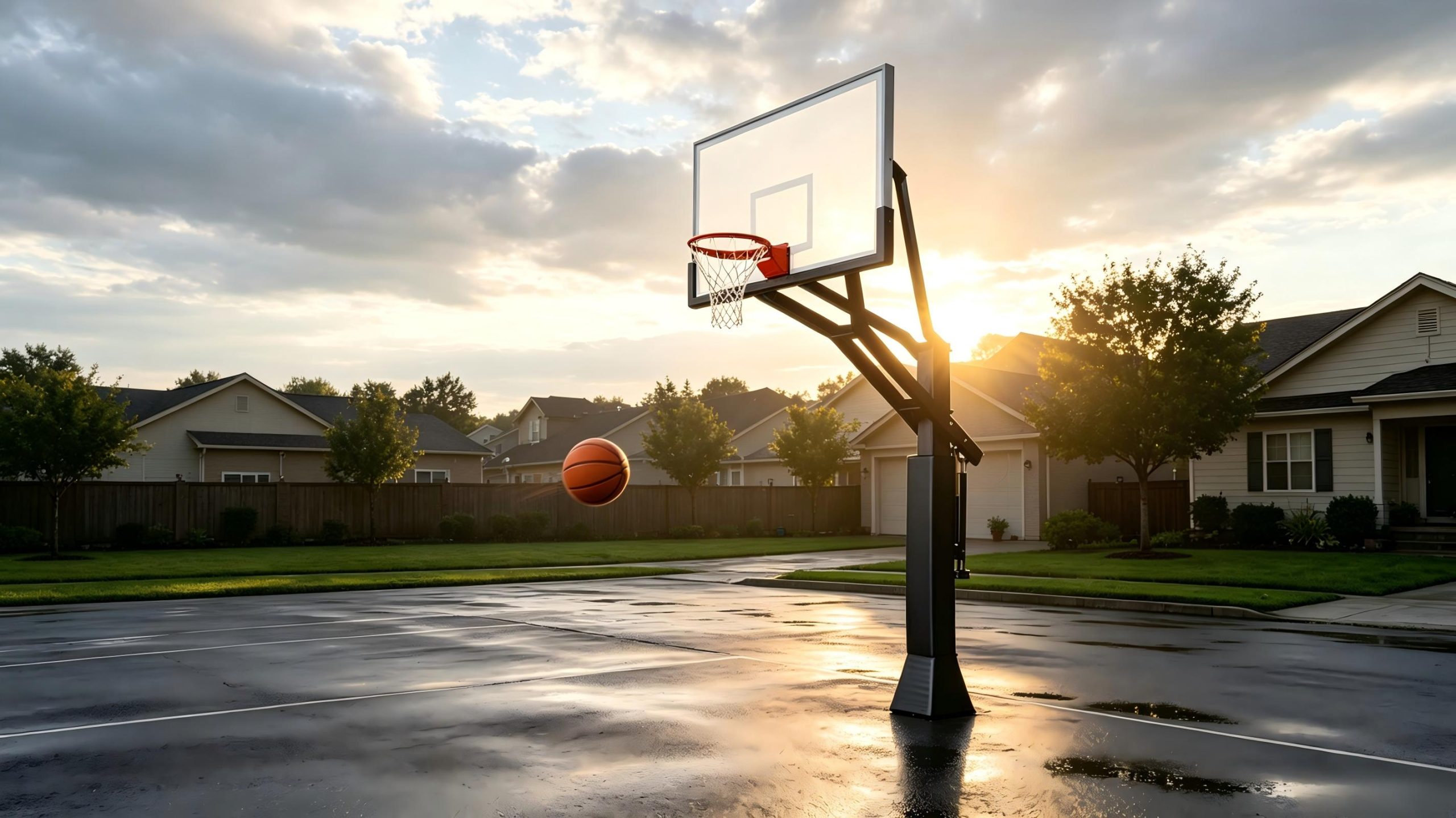
A regulation basketball rim sits exactly 10 feet or 3.05 meters above the finished court surface. This standardized vertical height applies across FIBA, the NBA, the NCAA, and all competitive high school programs. However, measuring rim height correctly requires distinguishing the rim ring from the backboard plate and support post. Youth athletic leagues frequently use lower target elevations ranging between six and nine feet for developmental safety. Precise measurement from the true playing floor ensures consistent gameplay and prevents costly installation errors on site.
How High Is a Basketball Rim?
The standard regulation height of a basketball goal measures exactly 10 feet above the finished playing surface. Converted to the metric measurement system, this universal vertical playing dimension corresponds precisely to 3.05 meters. Dr. James Naismith established this historic dimension in 1891 when he invented the game in Springfield, Massachusetts. He fastened the original peach baskets directly to the indoor running track railing inside the local gymnasium. Because that mezzanine balcony track happened to stand ten feet high, that arbitrary measurement became the permanent standard. Today, athletic governing bodies across the globe preserve this foundational benchmark to protect the integrity of basketball.
International sports federations such as FIBA strictly enforce the ten-foot standard across all sanctioned world tournaments. Similarly, North American organizations including the NBA, WNBA, and NCAA require identical vertical goal measurements for competition. Maintaining an exact basketball rim height preserves the fundamental visual mechanics and shooting angles that athletes master through practice. Even minor vertical deviations of one inch can noticeably alter player shooting percentages and rim rebound trajectories. Consequently, competitive athletic directors demand regular physical audits to ensure their sports goals meet established league standards.
Rim Height vs Backboard Height: What Is the Difference?
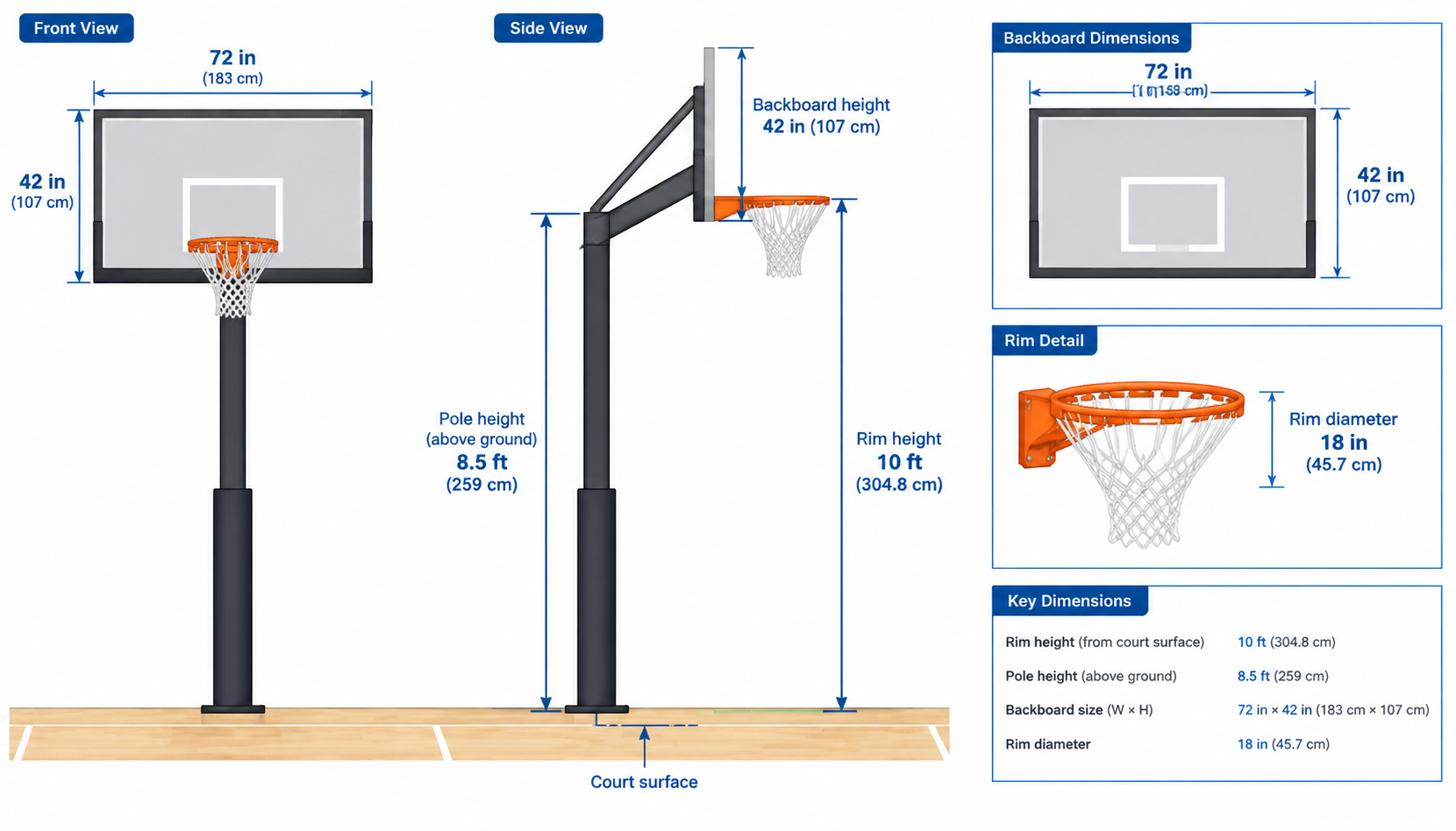
Sports facility planners often confuse rim height with overall backboard height when reviewing engineering blueprints for installations. Basketball rim height refers strictly to the vertical distance from the court floor to the top steel rim. In contrast, the backboard constitutes a separate structural plate that mounts securely behind the target rim assembly. A regulation competitive backboard measures 72 inches in total width by 42 inches in vertical structural height. Therefore, the lower edge of an official backboard sits exactly nine feet above the finished court surface. Meanwhile, the upper edge of that same regulation backboard structure rises to an elevation of 12.5 feet.
Support pole dimensions introduce an additional structural measurement that facility contractors must never mistake for playing height. In-ground goal posts frequently extend up to 13 feet high to anchor rigid cantilevered backboard extension arms. These extension arms project forward by four to five feet to establish a safe player overrun safety zone. Confusing total pole elevation with target ring height leads to disastrous installation mistakes on new athletic courts. Installers must always isolate the rim mounting bracket when setting goal elevations on commercial or residential courts.
Regulation, Youth, and Recreational Heights Compared
While adult competition adheres to ten feet, youth development programs benefit substantially from modified, lower basketball goal elevations. Young children lack the shoulder strength and spinal stability required to shoot regulation basketballs at ten-foot targets. Forcing young players onto regulation goals often causes flawed mechanics, erratic release motions, and long-term joint strain. Recognized youth development organizations therefore establish progressive rim heights tailored to player age, physical height, and strength. These scaled equipment dimensions allow younger athletes to develop balanced shooting form before advancing to higher playing levels.
| Age Bracket | School Grade Level | Recommended Rim Height | Official Ball Size | Recommended System Type |
|---|---|---|---|---|
| Ages 5 to 7 | Kindergarten to 1st Grade | 6.0 ft to 7.0 ft (1.83 m – 2.13 m) | Size 3 (22 inches) | Low-Profile Adjustable System |
| Ages 8 to 9 | 2nd Grade to 3rd Grade | 8.0 ft (2.44 m) | Size 5 (27.5 inches) | Adjustable In-Ground Goal |
| Ages 10 to 11 | 4th Grade to 5th Grade | 9.0 ft (2.74 m) | Size 6 (28.5 inches) | Institutional Adjustable Goal |
| Ages 12 and Up | 6th Grade through Adult | 10.0 ft (3.05 m) | Size 7 (29.5 inches) | Fixed or Commercial In-Ground |
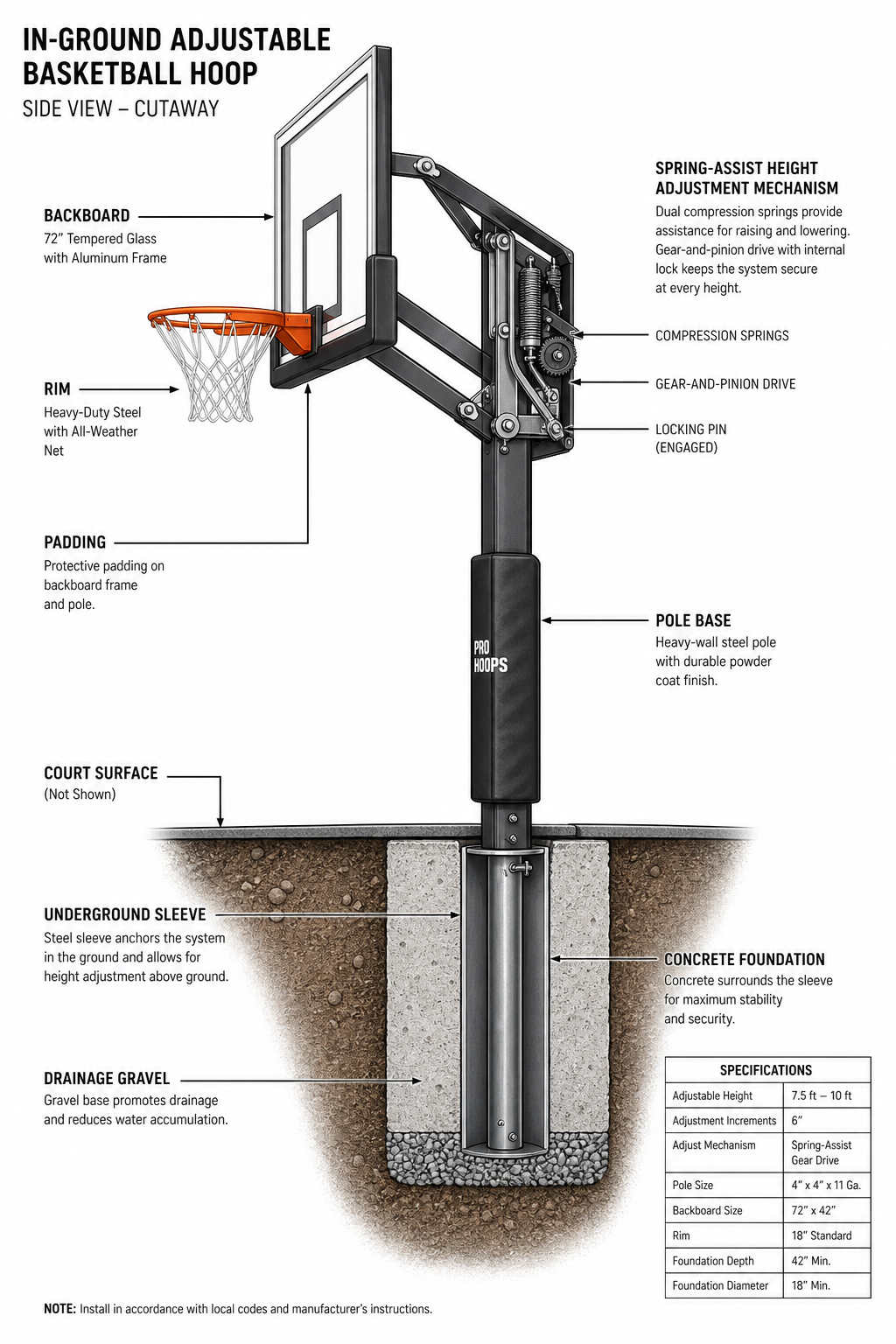
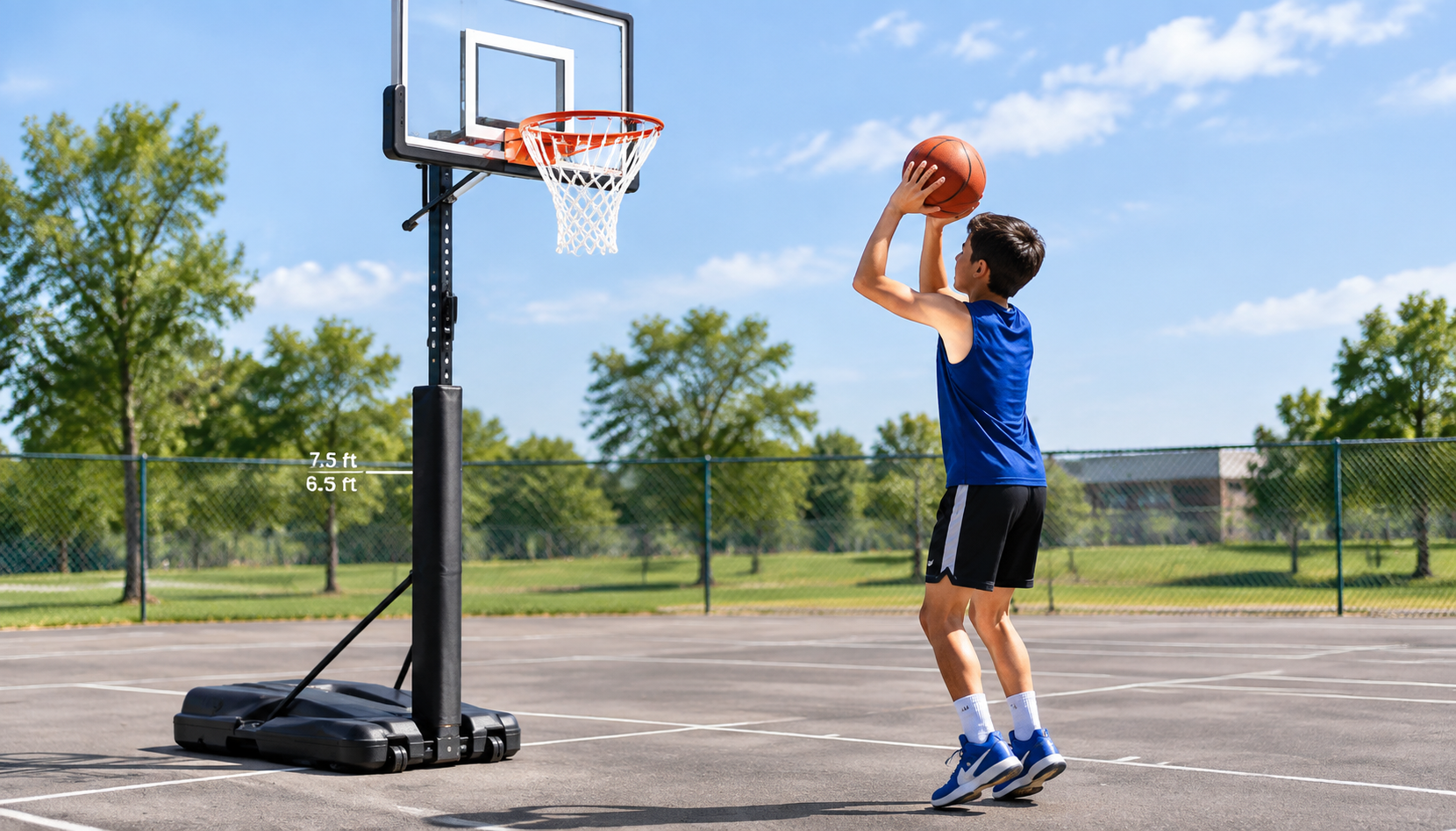
Adjustable basketball goal systems provide tremendous flexibility for multi-use gymnasiums, school districts, and community recreation centers. Modern height-adjustment mechanisms allow court operators to lower rims down to 7.5 feet for elementary youth training. Maintenance staff can subsequently return those same units to regulation ten-foot heights for evening adult recreation leagues. Investing in commercial adjustable systems maximizes facility scheduling versatility while supporting athletes across every developmental stage. Facility managers can review our comprehensive Basketball hoop specifications to evaluate structural load capacities and adjustment ranges.
How Do You Measure a Basketball Rim from the Court?
Measuring basketball goal elevation requires methodical execution to avoid inaccuracies caused by court slope or improper tool placement. Technicians must first locate the finished playing surface directly beneath the leading edge of the circular rim. Exterior concrete slabs frequently feature intentional slopes for stormwater drainage, which alters floor measurements across several feet. Therefore, measuring from the rear post rather than beneath the rim produces misleading and inaccurate height assessments. Position a rigid measuring tool directly underneath the front rim crown to capture the true vertical playing distance.
Technicians should utilize professional measuring tools such as telescopic fiberglass rods or calibrated laser distance measurement meters. The vertical measurement must terminate at the top interior surface of the rim rather than the lower net attachments. Furthermore, place a precision digital spirit level across the rim diameter to verify horizontal balance in every direction.
- Identify the finished playing surface datum point directly below the front center of the rim ring.
- Extend a rigid measuring rod vertically to the highest upper surface of the rim ring.
- Verify that the vertical reading equals exactly 10 feet or your target developmental dimension.
- Position a digital spirit level across the rim circumference to check front-to-back and side-to-side plane alignment.
- Inspect the backboard vertical plumb and confirm the mandatory four-foot baseline overhang clearance.
Rim-Height Checks Before Installation or Replacement
Pre-installation site surveys prevent costly structural mistakes when anchoring permanent in-ground basketball systems into concrete foundations. General contractors must establish the final finished floor elevation before excavating footings or setting steel anchor bolt cages. If concrete footings cure below final court surfacing levels, the attached goal will sit permanently below regulation height. Conversely, adding modular athletic tiles or asphalt overlays later without height adjustments creates an illegal playing goal height. Carefully calculating surfacing thickness during initial ground preparation ensures the installed hoop achieves its exact intended operational height.
Commercial anchor bolt systems incorporate dual-nut leveling designs that allow installers to fine-tune goal elevation after concrete curing. Installers adjust the lower leveling nuts beneath the post baseplate to achieve perfect vertical plumb and accurate elevation. Once the post aligns correctly, workers pack non-shrink commercial structural grout beneath the baseplate for lasting physical stability. In addition, routine preventative maintenance programs should inspect breakaway rim springs to prevent progressive sagging over active usage. Aggressive competitive dunking and heavy rim hanging can loosen pivot hardware and gradually reduce rim playing height over time.
- Confirm finished court elevation before pouring concrete footings to avoid unrecoverable vertical discrepancies.
- Calibrate adjustable height actuator stroke stops to prevent over-extension beyond official equipment design limits.
- Inspect baseplate leveling nuts to guarantee absolute vertical post alignment before applying structural non-shrink grout.
- Test breakaway rim tension regularly to prevent vertical rim drooping caused by repeated heavy athletic impacts.
Frequently Asked Questions About Basketball Rim Height
How high is a basketball ring in metric units?
In metric units, a regulation basketball ring stands at exactly 3.05 meters above the playing surface. This measurement converts directly from the historical ten-foot imperial standard established by basketball founders. Both FIBA international competitions and Olympic tournaments utilize this exact 3.05-meter specification for all official games. The inside diameter of the ring measures 450 millimeters, which equals approximately 18 inches across.
Does the rim height differ between men’s and women’s professional basketball?
No, basketball rim height does not differ between men’s and women’s professional competitive basketball leagues. Both the NBA and the WNBA play on rims set precisely at ten feet above the court floor. Similarly, NCAA collegiate programs and international FIBA tournaments utilize identical ten-foot heights for both genders. The primary equipment difference between men’s and women’s competition involves basketball circumference rather than rim playing elevation.
What is the regulation height of a basketball goal for middle school?
Middle school basketball leagues for seventh and eighth grade students compete on regulation ten-foot basketball rims. By age twelve, most young student athletes have developed sufficient physical strength to handle regulation goal heights properly. However, sixth-grade programs occasionally permit nine-foot goals depending on local league rules and athletic development policies. Facility operators hosting middle school tournaments should verify whether local governing bodies mandate regulation ten-foot equipment.
Can rim height change over time on an adjustable basketball hoop?
Yes, rim height can drift over time on adjustable basketball hoops due to mechanical wear and vibration. Repetitive ball impacts, heavy player dunks, and environmental temperature fluctuations can cause actuator components to loosen gradually. Additionally, hydraulic cylinders or mechanical screw jacks may experience subtle physical slipping after several seasons of intense use. Facility maintenance teams should conduct semi-annual height audits to recalibrate actuator stops and verify official rim elevations.
Why are basketball rims set at exactly 10 feet?
Basketball rims are set at ten feet because the first peach baskets were mounted to that elevation. Dr. James Naismith hung the original targets from the Springfield YMCA running track balcony in 1891. That physical balcony railing happened to sit exactly ten feet above the gymnasium hardwood floor during initial construction. Because that height created an ideal balance between offensive scoring and defensive challenge, officials made it permanent.
Partner with EVERGRAND Sport for Commercial Sports Equipment
EVERGRAND Sport manufactures high-performance basketball goals and sports systems engineered for schools, municipal parks, and athletic facilities. Our commercial-grade in-ground hoops and heavy-duty adjustable systems feature precision laser-cut steel posts and tempered glass backboards. Every system meets rigorous international safety benchmarks to ensure reliable structural stability across decades of demanding competitive play. We provide comprehensive OEM and ODM manufacturing services to international distributors, commercial contractors, and institutional equipment purchasers. Contact our engineering team today to request wholesale pricing, certified product specifications, or customized sports court planning assistance.