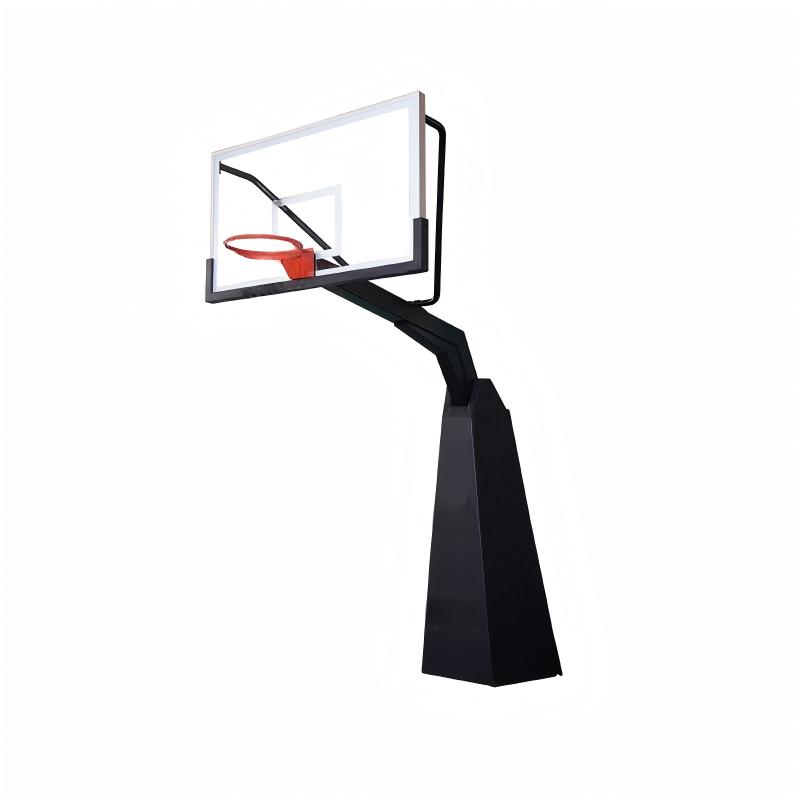
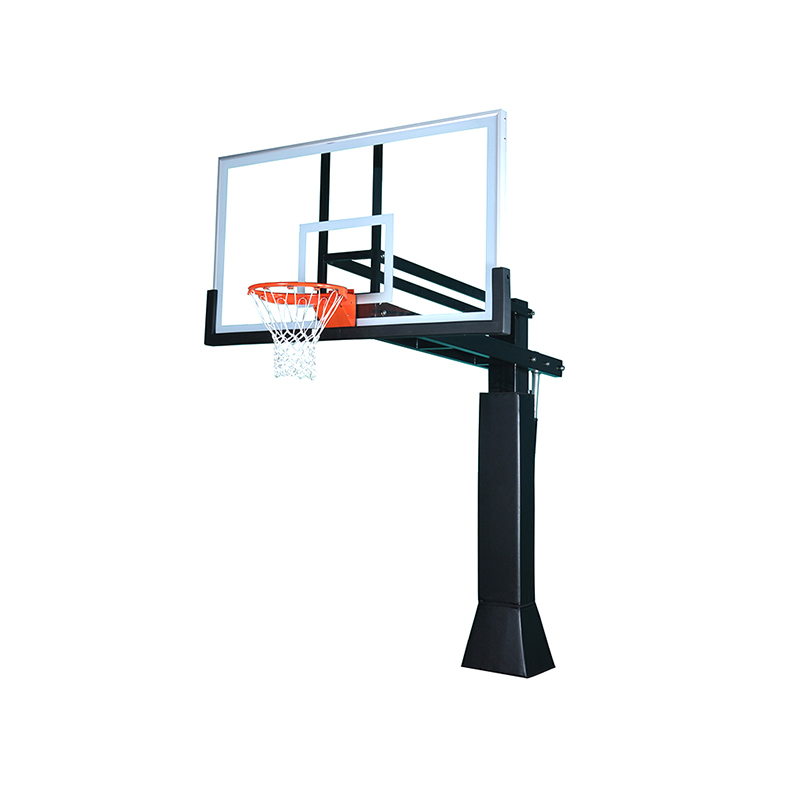
Basketball Hoop Guide
Types, Sizes,Materials, Installation& Buying Tips
For sports equipment distributors, stadium builders, and institutional contractors, sourcing certified athletic infrastructure requires absolute structural compliance and material traceability.
Home » Basketball Hoop Guide
What Is a Basketball Hoop?
A commercial basketball hoop system is a heavy-duty, engineered structural assembly designed to withstand thousands of Newtons of dynamic force. It integrates a support chassis, extension arm, perimeter frame, backboard face, and a calibrated breakaway rim to safely dissipate energy from intense athletic play into a reinforced foundation.
Basketball Hoops Main Components
A commercial-grade basketball hoop system operates as an integrated structural engineering assembly designed to manage extreme dynamic forces. The system consists of five primary components: the structural support pole or main chassis, the extension arm (overhang), the backboard perimeter frame, the backboard face, and the breakaway rim assembly.
Industrial systems utilize high-tensile structural steel (typically Q235 or Q345 grade) for the metal frameworks to prevent structural fatigue during high-impact plays and slam dunks. The anchoring foundation or ballast base provides the essential counterweight, ensuring the unit remains rigid under intense athletic stress and variable environmental loads.
How a Basketball Hoop Works
At its core, a professional basketball goal functions as a shock-absorption and energy-dissipation system. When a player dunks or the ball strikes the backboard, thousands of Newtons of kinetic energy transfer through the rim. Institutional systems route this energy away from the vulnerable backboard material.
Instead, a calibrated spring-loaded breakaway mechanism within the rim absorbs the initial impact before distributing the residual force down the heavy-gauge steel extension arm and main support post into the ground foundation or ballast system. This strategic energy path prevents backboard shattering, eliminates structural swaying, and ensures consistent ball rebound performance across the face of the board.
Types of Basketball Hoops
Industrial basketball systems are categorized into in-ground, portable, wall-mounted, adjustable, and heavy-commercial configurations. It can also be divided into outdoor basketball hoops and indoor basketball hoops based on where they are installed, the materials used, and the environmental conditions they are designed to withstand. Selecting the correct type depends on facility multi-functionality, spatial clearance restrictions, architectural load-bearing capacities, and the specific age demographics or competition levels of the target end-users.
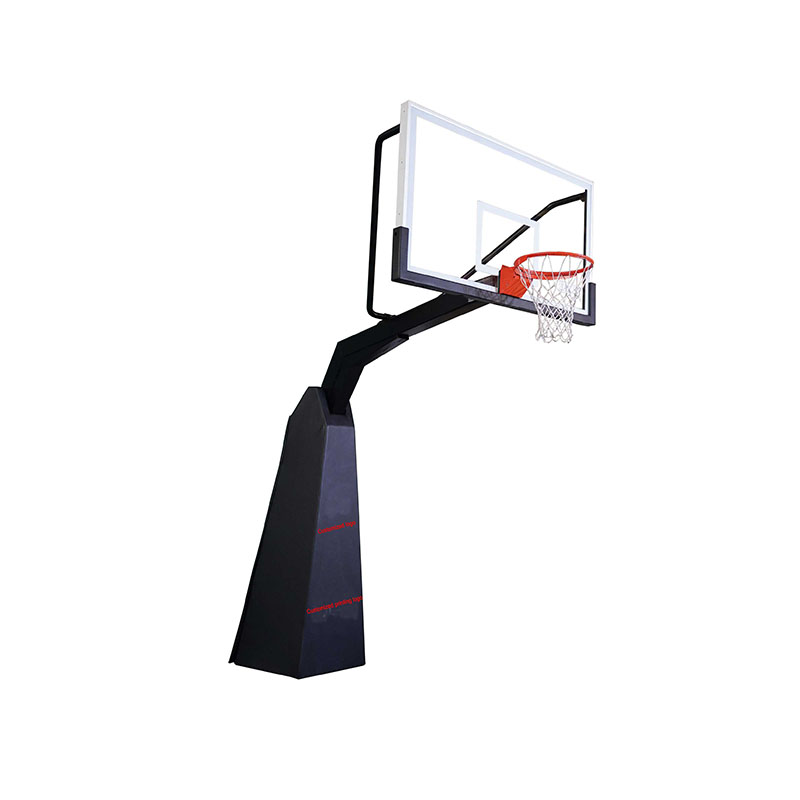
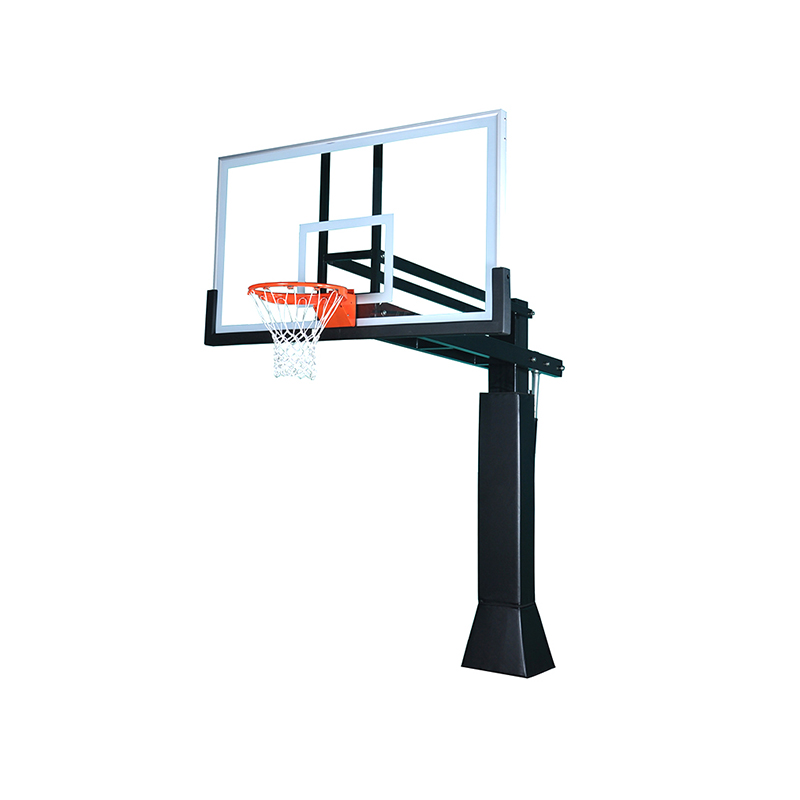
In-ground fixed height basketball hoops represent the pinnacle of permanent structural stability and professional-grade performance for outdoor and indoor facilities. Contractors secure these systems directly into a reinforced concrete footing using either a direct-burial method or a heavy-duty anchor bolt hinge system.
Industrial in-ground systems feature large single-piece steel posts (typically 6 x 6 inches to 8 x 8 inches with wall thicknesses exceeding 4.0mm) to minimize vibration. These systems provide excellent rebound performance and are the standard choice for public parks, school yards, and dedicated outdoor tournament courts where long-term durability and weather resistance are mandatory.
Portable basketball hoops offer unparalleled structural flexibility for multi-purpose arenas, commercial sports complexes, and flexible training facilities. Unlike lightweight residential units, commercial portable basketball systems rely on heavy-duty, integrated steel chassis frameworks equipped with high-density internal concrete ballast blocks or heavy cast iron weights.
These elite systems utilize advanced manual-hydraulic or electro-hydraulic lifting mechanisms to transition smoothly between operational positions and a folded storage footprint. Fitted with non-marking, high-load polyurethane casters, facility staff can easily roll these massive units across hardwood floors without causing structural damage or surface scuffing.
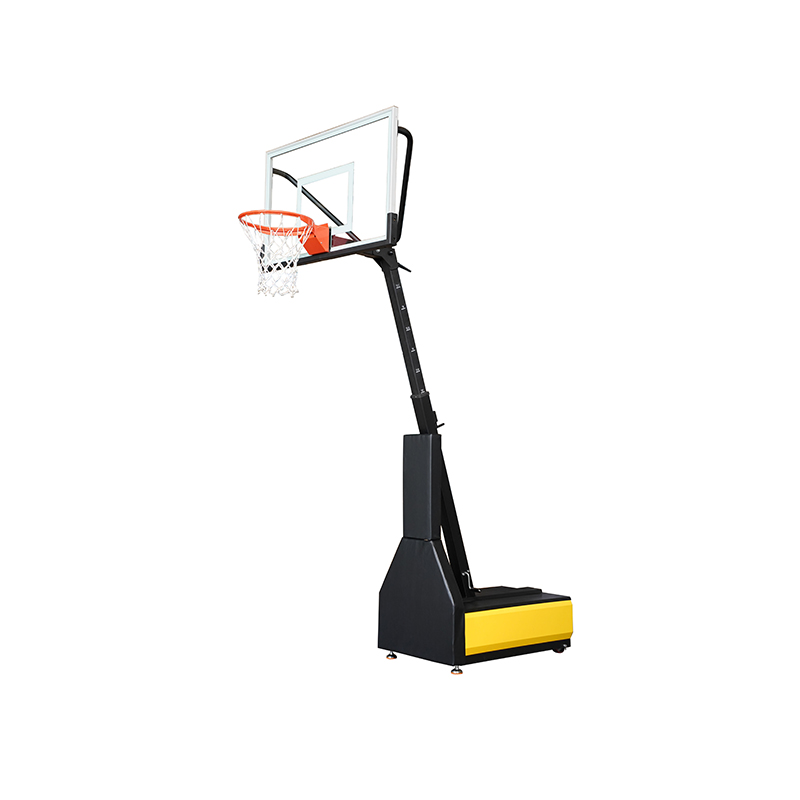
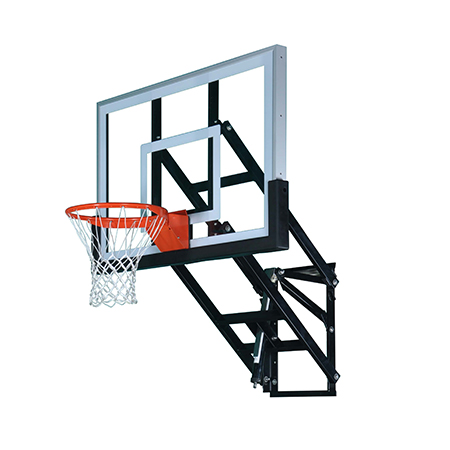
Wall-mounted basketball systems optimize floor space in indoor gymnasiums, school fitness centers, and space-constrained community halls. Engineers design these structures using heavy-gauge steel welded trusses that bolt directly into the building’s structural load-bearing walls or overhead concrete pillars.
Available in stationary, side-fold, or upward-fold configurations, facility managers can manually or electronically actuate these systems out of the way when the space is needed for non-basketball activities. Safety backup forward-fold mechanisms are standard inclusions to prevent sudden drop failures in the event of cable or actuator malfunctions.
Adjustable basketball hoops maximize facility utility across diverse age demographics and training programs. EVERGRAND SPORT designs institutional adjustable systems using internal heavy-duty screw-jack actuators or counterbalanced gas-shock lifting assemblies.
These precision mechanisms allow maintenance staff or coaches to alter the rim height smoothly from 2.30 meters (7.5 feet) up to the official 3.05 meters (10 feet). Crucially, the internal geometric design ensures that as the height adjusts, the backboard maintains its perfect vertical alignment and the extension arm overhang remains consistent with regulatory safety zones.
Basketball Hoop Sizes and Dimensions
Exact dimensional accuracy is non-negotiable for institutional sports infrastructure procurement. Adhering to standardized rim heights (3.05m), precise rim diameters (450mm), and official regulation backboard dimensions (1800mm x 1050mm) ensures compliance with FIBA, NCAA, and NBA governing criteria during structural bid evaluations.
You can visit our Basketball Hoop Size Guide.
Official Basketball Hoop Height
The official regulatory height for a professional basketball hoop is precisely 3.05 meters (10 feet), measured from the top edge of the steel rim vertically down to the playing court surface. This standard is strictly enforced across FIBA, NBA, and NNCAA competitions.
When manufacturing commercial systems, EVERGRAND SPORT adheres to a tight structural tolerance of less than ± 2mm . For facilities catering to multi-age training academies, our adjustable commercial units feature calibrated height indicator markings stamped directly onto the steel inner post for rapid, certified adjustments.
Learn more about the standard height for a basketball hoop
Basketball Rim Diameter
An official regulation basketball rim must feature an inside diameter of exactly 450 mm (18 inches). The rim must be constructed from a solid steel rod with a minimum thickness of 18 mm.
The rim assembly must also incorporate a net attachment system that eliminates sharp edges or open hooks, which can cause severe player finger injuries. Commercial rims must maintain perfect horizontal leveling; standard specifications require the rim to sit exactly parallel to the playing court floor, maintaining an even distance from the backboard face.
Learn more about how big is a basketball rim
Basketball Backboard Dimensions
The international standard dimension for a regulation professional backboard is 1800 mm in width by 1050 mm in height (approximately 72 inches by 42 inches), with a manufacturing tolerance zone of ±6mm.
The target rectangle centered behind the rim must measure exactly 590 mm horizontally by 450 mm vertically, marked with high-contrast 50 mm wide border lines. For high-level tournament configurations, the backboard must feature a minimum thickness of 10 mm to 12 mm when utilizing tempered glass to ensure standard rebound elasticity across the entire surface.
Youth Basketball Hoop Sizes
To support proper biomechanical and skill development in youth training facilities and middle schools, equipment dimensions scale down to match player ergonomics. For junior divisions (Ages 7–11), the official rim height lowers to 2.44 meters (8 feet) or 2.74 meters (9 feet).
Backboards for youth facilities are scaled down to 1370 mm x 900 mm (54 inches x 36 inches) or 1220 mm x 800 mm (48 inches x 32 inches). These compact dimensions reduce structural weight loads on adjustable arm extensions while providing an appropriate target area for smaller basketball sizes (Size 5 and Size 6).
| Technical Parameter | Official Regulation Specification | Youth/Junior Specification | Manufacturing Tolerance |
| Rim Height | 3.05 meters (10 feet) | 2.44m (8 feet) / 2.74m (9 feet) | ±2mm |
| Rim Inside Diameter | 450 mm (18 inches) | 450 mm (Standard sizing applies) | ±0.5mm |
| Backboard Dimensions | 1800 mm × 1050 mm (72″ × 42″) | 1370mm × 900mm / 1220mm × 800mm | ±6mm |
| Inner Target Box | 590 mm × 450 mm | 590 mm × 450 mm (Maintained) | ±2mm |
| Extension Arm Overhang | 1.20 meters to 3.25 meters | 0.60 meters to 1.20 meters | ±10mm |
Basketball Hoop Materials Explained
Material science dictates the durability, performance, and application environment of a basketball goal. Combining Q235/Q345 structural steel frames with specialized backboards—such as elite tempered glass, unbreakable outdoor polycarbonate, lightweight acrylic, or vandal-resistant steel—optimizes the system’s longevity against climate extremes and mechanical impacts.
Steel Basketball Hoop Frames
Built from high-strength Q235 and Q345 structural steel, our hoop frames feature robotic MIG welding, hot-dip galvanization, and powder coating for superior stability, impact resistance, and long-term outdoor corrosion protection.
Polycarbonate & Acrylic Backboards
Polycarbonate and acrylic backboards provide durable, lightweight alternatives to glass. Polycarbonate offers maximum impact resistance for public courts, while acrylic delivers improved rebound performance and a professional transparent appearance.
Tempered Glass Backboards
Professional-grade 10–12mm tempered glass backboards deliver the most authentic ball rebound, exceptional optical clarity, and long-term durability, making them the preferred choice for competitive indoor and outdoor basketball facilities.
Breakaway Rim Tech
Advanced breakaway rim technology uses precision-calibrated spring mechanisms to absorb dunking forces, reduce backboard stress, enhance player safety, and ensure consistent performance in high-intensity basketball environments.
| Material Feature | Tempered Glass | Polycarbonate | Acrylic (Plexiglas) | Perforated Steel / Alum |
| Rebound Performance | Elite (100% Coefficient) | Dampened / Soft | Moderate to High | Low to Moderate |
| Impact/Vandal Safety | High (Dull granules) | Extreme (Unbreakable) | Moderate (Shatter-resist) | Absolute (Vandal-proof) |
| Optical Clarity | Permanent 100% Clear | Prone to UV yellowing | High UV stability | Opaque / Painted |
| Optimal Deployment | Indoor Arenas / Gyms | Public parks / Playgrounds | Recreation clubs | Urban streetball courts |
International Standards & Safety Compliance
Meeting safety and performance regulations is mandatory for municipal and stadium building tenders. High-performance basketball configurations must carry validated compliance markings confirming conformity to FIBA Level 1, 2, or 3 classifications alongside rigorous testing requirements set by European EN 1270 and American ASTM criteria.
FIBA Levels
Level 1 for ProTournaments; Levels 2& 3 for schools and regional leagues.Requires specific extension lengths and safety padding.
EN 1270 (EU)
Categorizes Class A-E. Requires static vertical load tests of up to 240kg without permanent structural deformation.
ASTM (USA)
Governs material safety, including salt-spray corrosion testing and lead-free padding composition certifications.
Portable vs. In-Ground Basketball Hoops
The choice between portable and in-ground basketball hoop structures balances site flexibility against absolute mechanical permanence. Portable systems optimize multi-sport indoor layouts through rapid deployment and space reconfiguration, whereas in-ground foundations deliver maximum structural vibration reduction and cost-effective, long-term exterior durability.
Advantages of Portable Basketball Hoops
The primary advantage of a commercial portable basketball system is operational versatility. Multi-purpose indoor arenas can quickly transition from a professional basketball configuration to hosting concerts, exhibitions, or volleyball tournaments within a matter of hours.
Because portable systems do not require permanent concrete installation or ground excavation, facility managers can easily relocate them to different areas or transport them to a new facility if lease terms change. Additionally, storage features allow the units to fold down compactly, fitting neatly into standard equipment storage rooms when not in use.
Advantages of In-Ground Basketball Hoops
In-ground basketball goals provide maximum structural rigidity, a compact physical footprint, and unmatched cost efficiency over long-term lifespans. By anchoring directly into a deep concrete foundation, these units eliminate the need for a massive, space-consuming base chassis on the playing surface, freeing up valuable baseline clearance zones.
The direct foundation connection eliminates mechanical vibration, providing a quiet, stable rebound experience favored in outdoor courts. Lacking complex hydraulic pumps, internal lifting cables, or moving wheel casters, in-ground systems require virtually zero ongoing mechanical maintenance, making them highly cost-effective for municipal budgets.
Which Basketball Hoop Is Right for You?
Selecting between portable and in-ground configurations requires a detailed assessment of facility utility and spatial constraints. If your project involves a multi-sport indoor stadium or a rented commercial property where permanent floor alterations are prohibited, high-end portable systems are the clear logistical choice.
Conversely, if you are outfitting an outdoor public park, a dedicated school playground, or a fixed-layout outdoor community court, permanent in-ground systems provide superior durability, anti-vandalism security, and a maintenance-free lifecycle at a lower initial procurement cost.
Visit our Basketball Hoop Buying Guide for more ideas.
How to Choose the Right Basketball Hoop
Sourcing specifications must align precisely with the targeted structural application environment. Procurement criteria scale drastically depending on installation parameters: high-end residential communities require anchor-bolt versatility, schools demand heavy structural safety, municipal parks require anti-vandalism designs, and professional arenas require FIBA certification.
For Home Driveways
When selecting equipment for high-end residential developments, estate communities, or executive home driveways, buyers look for premium performance combined with structural safety. For these projects, premium 5 x 5 inch or 6 x 6 inch adjustable in-ground hoops featuring a 54-inch or 60-inch acrylic or tempered glass backboard are ideal.
An internal crank-adjustment system allows families of varying ages to utilize the hoop safely. Choosing a system with an anchor-bolt hinge foundation allows the homeowner to unbolt and relocate the entire hoop assembly if they move properties in the future.
For Schools
School environments demand durable sports equipment capable of handling continuous, rough daily use by hundreds of students. For outdoor school yards, we recommend heavy-duty, fixed-height 4.0mm thick in-ground steel posts equipped with 60-inch unbreakable polycarbonate or steel backboards and double-ring breakaway rims.
For indoor school gymnasiums, ceiling-suspended or wall-mounted folding systems are preferred, as they allow physical education instructors to clear the floor space for other sports while keeping the equipment safely out of reach when unsupervised.
For Parks and Communities
Municipal public parks and community recreation centers require maximum protection against vandalism, extreme weather conditions, and structural neglect. The optimal configuration for these spaces is an ultra-heavy-duty, fixed-height in-ground system featuring an 8-inch hot-dip galvanized steel post.
Pairing this post with a perforated steel or heavy-gauge aluminum backboard prevents graffiti damage and wind-load stress. For added durability, replacing traditional nylon nets with zinc-plated steel chain nets prevents wear from weathering and cutting, ensuring a maintenance-free lifespan in unmonitored public areas.
For Professional Courts
Professional arenas, university stadiums, and elite sports training academies require top-tier equipment that meets strict regulatory standards. These facilities need FIBA Level 1 or Level 2 certified portable hydraulic systems or high-grade ceiling-suspended structures with 72-inch tempered glass backboards.
The rims must include precision-calibrated positive-lock breakaway mechanisms to ensure consistent rebound characteristics across the court. Additionally, the system must feature 100mm thick high-density safety padding, custom branding options, and integrated connections for electronic shot clocks and tournament scoring hardware.
Basketball Hoop Installation Guide
Engineering execution during structural setup preserves system longevity and user safety. Proper installation follows a linear technical sequence: rigorous subsurface utility mapping, high-strength concrete foundation pouring (3000+ PSI), mechanical alignment verification, and total torque compliance checks prior to operational commissioning.
How Much Does It Cost to Install a Basketball Hoop?
For commercial and institutional procurement budgets, installation costs vary based on site accessibility, soil conditions, and system complexity. A standard commercial in-ground hoop installation typically ranges from $500 to $1,500 per unit, covering excavation, concrete, rebar, and multi-person assembly labor.
Large-scale portable arena systems do not require ground excavation but may involve $300 to $800 in specialized assembly, mechanical calibration, and ballast-loading labor. Wall-mounted or ceiling-suspended projects generally require $1,000 to $3,000 per unit due to structural engineering assessments and working-at-height rigging requirements.
Factors That Affect Basketball Hoop Installation Cost
Several factors can influence the total basketball hoop installation cost. Understanding these variables helps you estimate your budget more accurately.
- Type of Basketball Hoop – A fixed basketball hoop usually costs more to install because it requires a permanent concrete foundation, while portable hoops require little or no installation.
- Ground Conditions – Installing on an existing concrete slab is generally less expensive than digging a new hole, pouring concrete, and preparing a stable base.
- Hoop Size and Weight – Larger and heavier basketball hoops often require additional labor, specialized tools, or lifting equipment, increasing the installation price.
- Labor Costs – Installation rates vary by location. Urban areas typically have higher labor costs than rural regions.
- Site Preparation – Uneven ground, landscaping, or removing existing structures can add to the overall installation cost.
- Additional Equipment – Some heavy-duty or commercial basketball hoops require cranes or other machinery, which can significantly increase the final price.
- Permits and Local Regulations – In some areas, permits or inspections may be required, adding extra costs to the project.
By considering these factors before purchasing a basketball hoop, you can better estimate your total installation cost and avoid unexpected expenses.
Basketball Hoop Maintenance Tips
Preventative maintenance protocols protect capital investments from early structural degradation. Implementing a routine safety schedule—including non-abrasive polymer board cleaning, net weathering replacement, mechanical breakaway spring calibration, and cold-galvanization rust touch-ups—maintains the system’s structural integrity.
Backboard Maintenance
Regular backboard maintenance preserves structural visibility and ensures consistent ball rebound action. For tempered glass backboards, maintenance crews should clean the surface using non-abrasive glass cleaners and soft microfiber towels to prevent surface scratching.
For outdoor acrylic or polycarbonate boards, cleaning requires mild soap and water solutions; harsh chemical solvents or ammonia-based cleaners must be avoided, as they can degrade the polymer structure and cause premature yellowing. During cleaning, technicians must inspect the perimeter aluminum framing and back-brace bolts for signs of loosening or structural stress.
Rim and Net Replacement
Rims and nets experience direct physical contact during play, requiring regular inspection and proactive parts replacement. Nylon nets in high-traffic outdoor courts typically require replacement every 6 to 12 months due to UV degradation and fraying.
During net replacement, technicians must check the rim’s breakaway housing for signs of spring fatigue or rusted internal components. If the rim fails to snap back instantly into a level position after a load test, the internal spring mechanism or the entire rim assembly must be replaced immediately to maintain court safety.
Rust Prevention
Proactive rust prevention is critical to extending the operational lifespan of sports infrastructure in outdoor environments. Maintenance staff should conduct quarterly inspections of all steel welds, post joints, and assembly hardware.
If wind-blown debris or physical impact scratches the powder coating, the exposed steel must be sanded down, treated with a zinc-rich anti-corrosion primer, and touched up with weather-resistant industrial topcoat paint. For coastal facilities, washing down the metal frameworks with fresh water removes salt accumulations, preventing accelerated galvanic corrosion.
Basketball Hoop Applications
Basketball systems serve as specialized physical infrastructure across diverse public and private sectors. Tailoring system specifications to distinct deployment zones—such as premium residential complexes, high-use schools, urban public parks, or profit-driven commercial athletic arenas—ensures optimal performance and safety.
Residential Basketball Courts
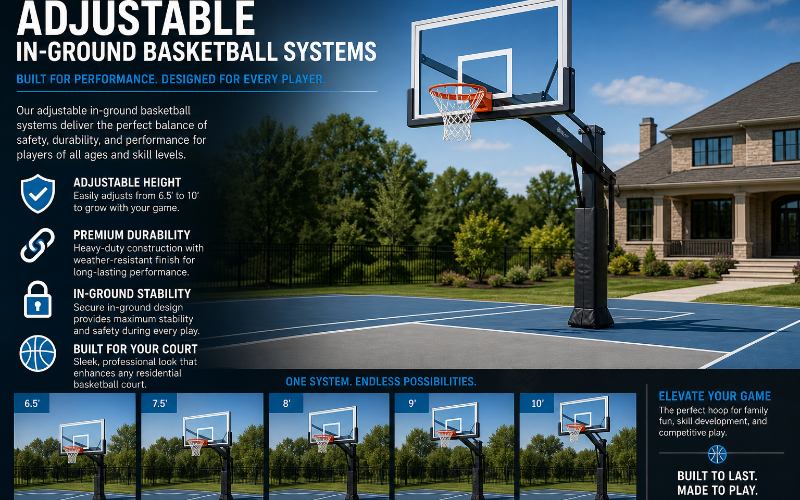
In high-end residential developments, private estates, and luxury apartment complexes, basketball courts serve as premium recreational amenities. Equipment for these applications must deliver professional-grade playability while matching the clean, modern look of the surrounding property.
Installing premium adjustable in-ground basketball systems with clear tempered glass backboards and internal height adjustment cranks meets the needs of players of all ages, from children learning fundamental skills to adults playing competitive recreational games.
School Basketball Courts
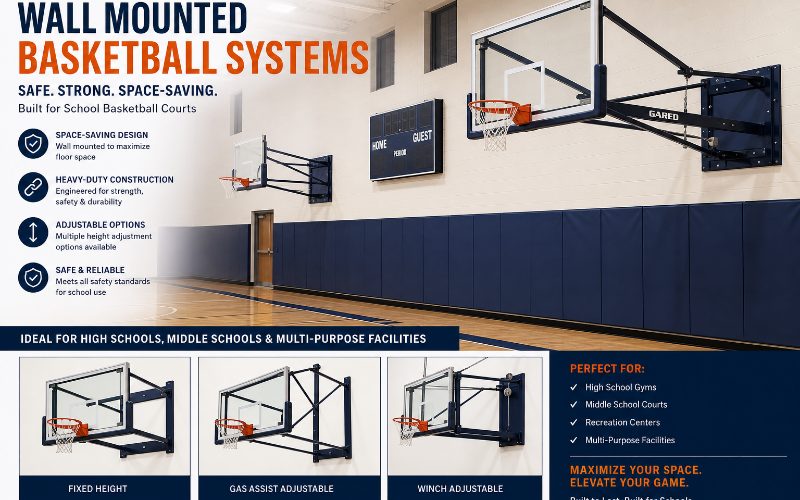
School basketball courts are multi-functional spaces used for physical education classes, after-school intramural programs, and high-intensity inter-scholastic tournaments. Equipment in these environments must be durable, safe, and easy for staff to operate.
Indoor facilities rely on motorized ceiling-suspended or wall-mounted folding systems to quickly adjust the room layout for different sports. Outdoor school yards utilize ultra-durable, fixed-height in-ground steel posts to ensure the equipment survives constant use and heavy physical play throughout the academic year.
Community Sports Facilities
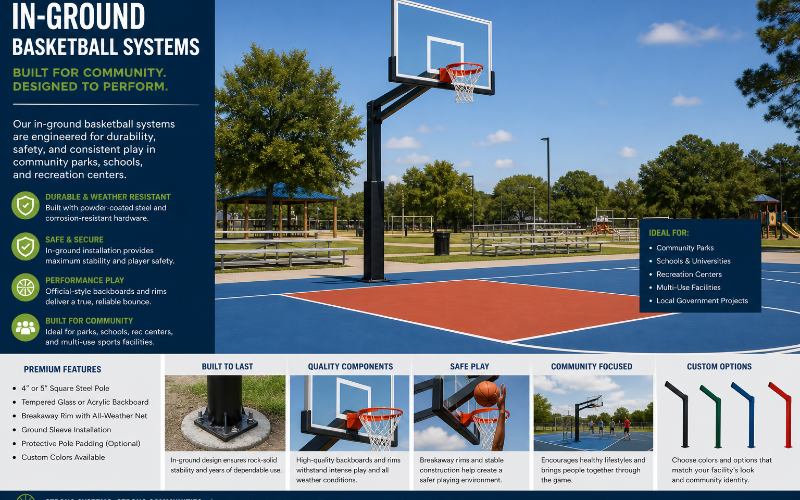
Local youth clubs, municipal recreation centers, and public parks require basketball equipment that balances performance with long-term durability. These community facilities operate on tight public budgets, making equipment lifespan and low maintenance costs top priorities.
By choosing commercial-grade in-ground hoops with weather-resistant powder coatings, unbreakable polycarbonate backboards, and steel chain nets, city councils can provide high-quality recreational infrastructure that remains safe and operational for years without requiring costly repairs.
Commercial Sports Complexes
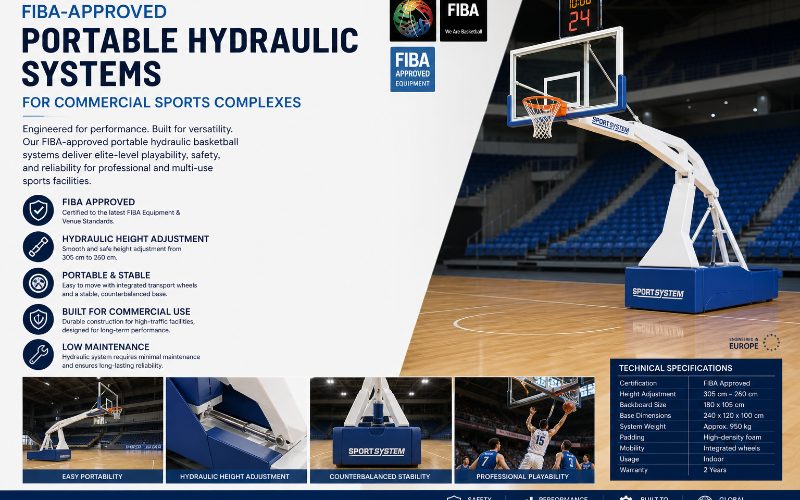
Commercial sports complexes, pay-to-play training facilities, and multi-court tournament venues operate under a business model focused on maximizing court rental time and attractions for premium sporting events. These high-tier venues require top-of-the-line equipment, such as FIBA-approved portable hydraulic systems.
These elite systems allow staff to reconfigure court layouts within minutes, feature integrated electronic wiring for shot clocks and television broadcasting, and deliver the precise rebound and safety compliance demanded by professional leagues and competitive tournaments.
How to Choose a Basketball Hoop Manufacturer
Selecting a global industrial manufacturing partner requires evaluating core manufacturing metrics. B2B buyers must evaluate a factory’s technical background, verifying ISO/EN quality qualifications, custom CAD engineering options, turnkey OEM/ODM scalability, and multi-stage quality control to guarantee reliable product delivery.
Manufacturing Experience
Choose a manufacturer with extensive industry experience, advanced production technology, and stable supply chains to ensure consistent product quality.
Quality Certifications
Select a supplier whose factory and products are certified to internationally recognized quality, safety, and environmental standards.
Customization Capabilities
A professional manufacturer should offer flexible customization services to meet the specific requirements of different sports facility projects.
OEM & ODM Services
Reliable OEM and ODM services enable distributors to build their own brand with customized products, packaging, and private labeling.
Quality Control Process
A comprehensive quality control system ensures every basketball hoop is thoroughly inspected before shipment for safety, durability, and performance.
After-Sales Service
Choose a manufacturer that provides comprehensive warranties, responsive technical support, and readily available replacement parts to ensure long-term reliability and lower maintenance costs.
Why Choose EVERGRAND SPORT as Your Basketball Hoop Supplier
EVERGRAND SPORT operates as a true factory-direct manufacturer, providing global B2B clients with significant competitive advantages. Our vertical integration allows us to maintain stable production timelines and control quality at every stage.
Technical Capabilities
- Automated robotic welding arms for seamless
joints - High-precision CNC laser cutting
- Large-scale electrostatic powder coating lines
- Custom CAD and 3D modeling engineering
department
Quality Control (QC)
- Raw material tensile strength analysis
- Salt-spray chambers for anti-rust verification
- Dynamic stress testing on breakaway rims
- Pre-shipment structural assembly checks
FAQ
What is the standard height of a basketball hoop for professional and institutional facilities?
The official standard height for a regulation basketball hoop is exactly 3.05 meters (10 feet) from the top edge of the rim to the playing court surface. This measurement is strictly mandated by FIBA, NBA, NCAA, and high school athletic associations globally. For multi-age institutional facilities, EVERGRAND SPORT manufactures adjustable commercial systems that allow precision height calibration from 2.30 meters to 3.05 meters while maintaining full structural safety and regulatory alignment.
How deep should the concrete footing be for a commercial in-ground basketball hoop?
Commercial in-ground basketball hoop installations typically require an excavated foundation hole measuring 600mm to 900mm in diameter and 1200mm to 1500mm in depth. The exact depth must extend below the local geographic frost line to prevent seasonal soil heave from unleveling the post. EVERGRAND SPORT recommends reinforcing this footing with structural rebar and using high-strength concrete rated at 3000 to 4000 PSI to properly secure heavy-duty 6 x 6 inch or 8 x 8 inch steel support posts.
What is the best basketball hoop material and type for public schools and municipal parks?
For public schools and municipal parks, the best configuration is a heavy-duty fixed-height in-ground basketball hoop constructed from a minimum 4.0mm thick steel post, paired with an unbreakable polycarbonate or perforated steel backboard and a double-ring breakaway rim. This material setup delivers maximum resistance against physical vandalism, heavy daily use, and extreme weather conditions, providing municipal budgets with a low-maintenance, long-term athletic solution.
How long does a commercial-grade basketball hoop last in outdoor environments?
A certified commercial-grade basketball hoop manufactured by EVERGRAND SPORT features an operational lifespan exceeding 10 to 15 years in outdoor environments. This longevity is achieved by using high-tensile structural steel that undergoes industrial hot-dip galvanization and a baked-on electrostatic powder coating, protecting the internal framework from rust, UV yellowing, and environmental degradation even in high-humidity coastal regions.
Can basketball hoops be customized for OEM/ODM wholesale orders?
es, commercial basketball hoops can be fully customized through EVERGRAND SPORT’s comprehensive OEM/ODM manufacturing services. Our factory can modify extension arm overhang lengths, post dimensions, backboard material choices, and custom color powder coatings to match specific project designs or school branding. Additionally, we provide custom corporate logo printing on safety chassis padding and design flat-pack retail or wholesale packaging to optimize international shipping container space.