As a system integrator for sports facilities, selecting the appropriate basketball hoop system is a critical decision that impacts player safety, game performance, facility versatility, and long-term operational costs. A nuanced understanding of basketball hoop sizes, dimensions, and specifications is paramount to ensure compliance with official regulations, accommodate diverse user groups, and deliver optimal value. This guide provides a technical deep dive into basketball hoop sizing, tailored specifically for procurement managers, facility developers, and contractors.
Key Takeaways for System Integrators
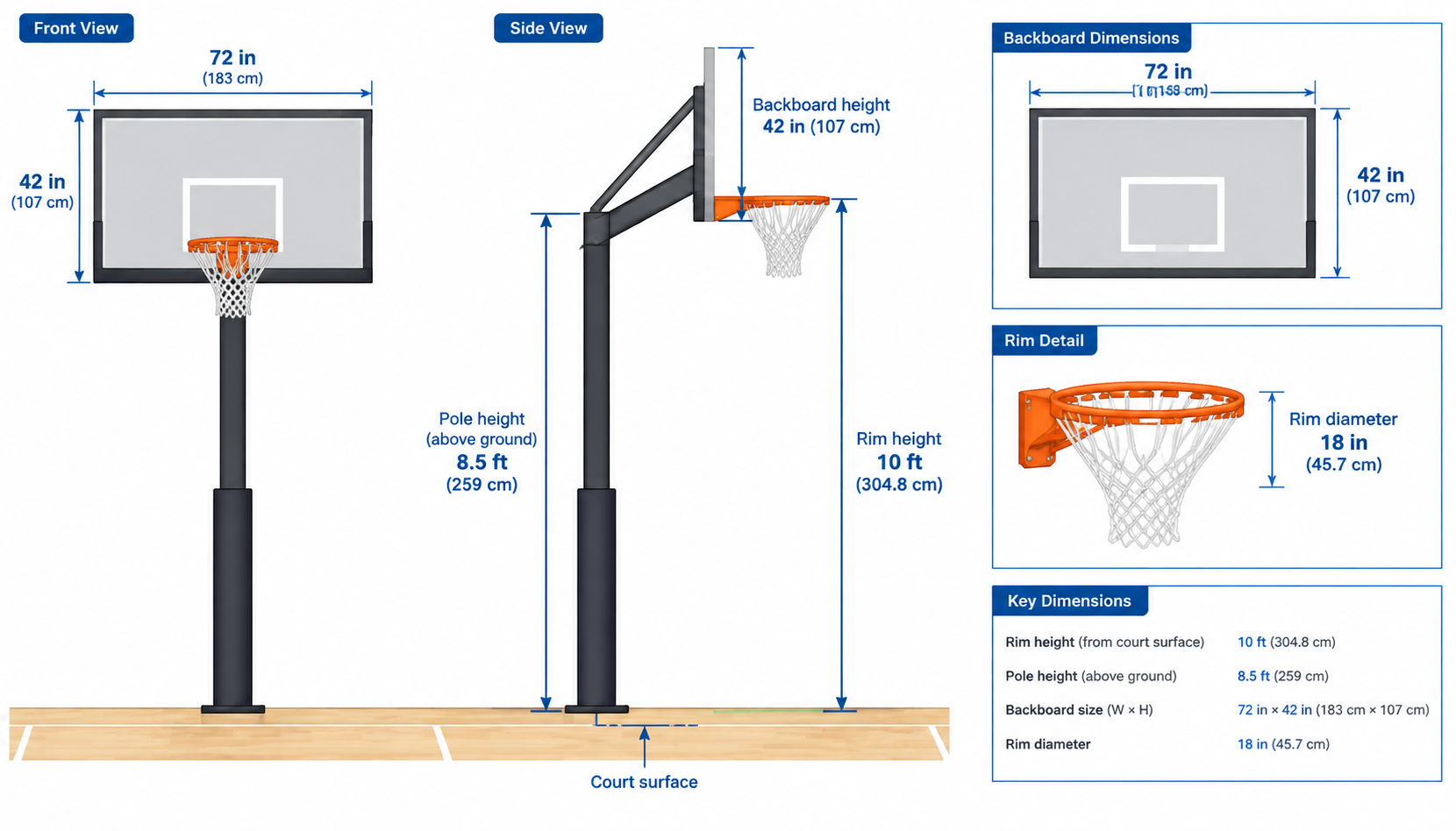
- Standard Dimensions Are Key: Regulation basketball hoops feature an 18-inch (45.72 cm) rim diameter mounted precisely 10 feet (3.05 meters) above the playing surface.
- Backboard Size Varies by Application: While professional play mandates 72″ x 42″ (1.83m x 1.07m) backboards, schools and recreational facilities often utilize smaller, more durable options like 60″ x 36″ or 54″ x 36″.
- Intended Use Dictates System Type: Commercial-grade installations require robust in-ground, wall-mounted, or ceiling-mounted systems with appropriate pole gauges and extension arms for durability and safety.
- Adjustability is Crucial for Versatility: For multi-age facilities (schools, community centers), systems with easy and secure height adjustment mechanisms are essential.
- Prioritize Safety and Compliance: Ensure all chosen equipment meets relevant safety standards (e.g., ASTM, FIBA, NCAA) and local building codes for player protection and liability mitigation.
- Material Selection Matters: Tempered glass offers superior rebound for professional play, while acrylic and polycarbonate provide durability and cost-effectiveness for schools and outdoor use.
What Constitutes a Standard Basketball Hoop?
A standard basketball hoop system is an assembly of several key components, each with specific dimensions and material requirements that collectively define its performance, durability, and safety. Understanding these elements is fundamental for any system integrator.
Backboard Dimensions: Material and Size Considerations
The backboard is a primary surface for rebound and shot accuracy. Its size and material significantly impact gameplay and durability.
- Regulation Size (Professional/Collegiate): The official size for professional (NBA) and collegiate (NCAA, FIBA) play is 72 inches (1.83 meters) wide by 42 inches (1.07 meters) high. This provides a generous target area and consistent rebound.
- School & Commercial Use: Common commercial backboard sizes include 60 inches wide by 36 or 42 inches high, or 54 inches wide by 36 inches high. These are more economical, often more durable for high-traffic environments, and still offer excellent playability for various skill levels.
- Youth & Recreational: Smaller backboards, such as 48 inches wide by 32 inches high, are sometimes used for junior leagues or very confined spaces, though less common in professional B2B installations due to the need for versatility.
Material Choices:
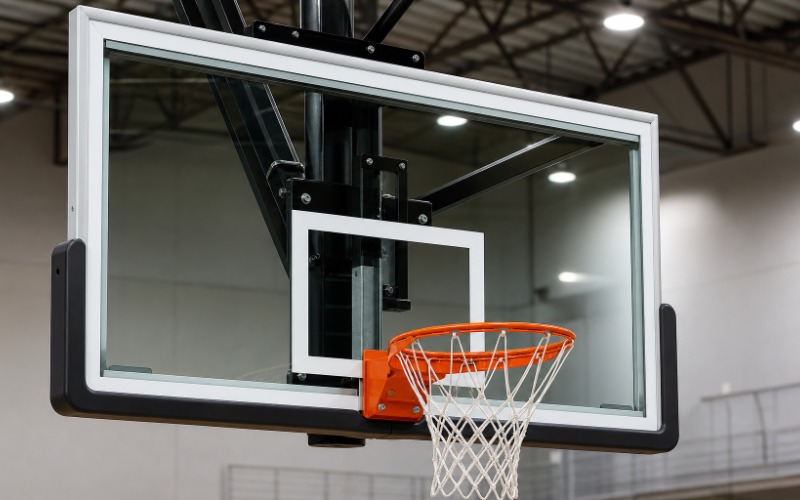
- Tempered Glass: Offers the best rebound and professional aesthetics. It is highly durable but can shatter under extreme stress, making it ideal for indoor pro/collegiate use where maintenance is regular.
- Acrylic: A transparent plastic alternative to glass, offering good rebound at a lower cost and higher impact resistance. Commonly used in high schools, community centers, and outdoor commercial hoops due to its weather resistance and durability.
- Polycarbonate: Even more durable and impact-resistant than acrylic, making it an excellent choice for heavily used outdoor courts, public parks, and entry-level institutional settings where extreme resilience is prioritized over professional-grade rebound.
- Fiberglass/Steel: Fan-shaped or rectangular steel backboards are typically found in older or more budget-conscious outdoor public parks. While extremely durable, they offer less predictable rebound.
Rim Diameter and Height: Precision Engineering for Fair Play
- Standard Rim Diameter: All regulation basketball hoops, regardless of the level of play, utilize a rim with an inside diameter of 18 inches (45.72 cm). This dimension is crucial for consistent shot dynamics.
- Regulation Height: The top of the rim must be precisely 10 feet (3.05 meters) above the playing surface. This standard applies across all levels of organized basketball, from youth leagues (for older age groups) to professional play.
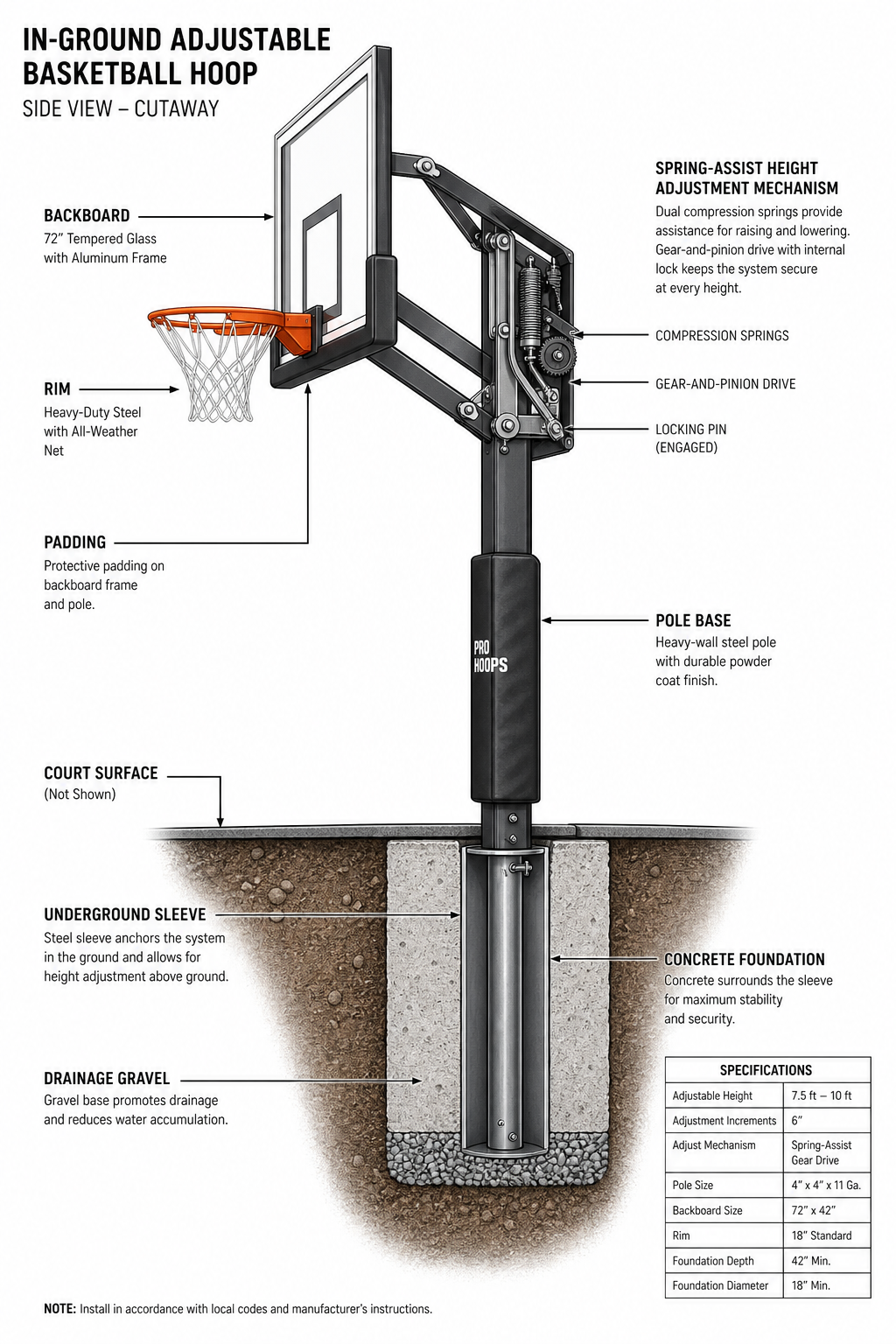
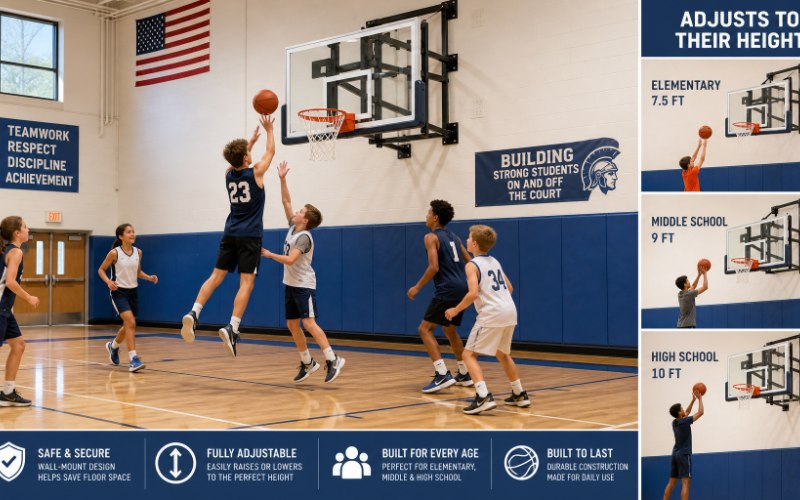
- Adjustable Height Systems: For facilities catering to younger players or diverse age groups, adjustable height systems are indispensable. These systems allow the rim to be lowered to 9 feet, 8 feet, or even 7 feet for youth development. Ensure the adjustment mechanism is robust, secure, and easy for facility staff to operate, without compromising stability at any height.
Extension Arm/Overhang: Ensuring Player Safety and Court Versatility
The extension arm, also known as the overhang or setback, is the distance from the support pole or wall to the front face of the backboard. This dimension is critical for player safety and maximizing court space.
- Optimal Setback for Safety: A longer extension arm moves the pole further from the playing area, reducing the risk of player collisions with the support structure. For professional and high-level collegiate play, setbacks of 4 feet (1.22 meters) or more are common.
- Common Commercial Setbacks: For schools, community centers, and recreational facilities, setbacks typically range from 2 feet to 4 feet. A 3-foot (0.91 meter) or 4-foot setback is often a good compromise between safety, cost, and structural requirements.
- Wall-Mounted Systems: These systems have a fixed setback determined by the mounting brackets, often ranging from 2 feet to 6 feet, depending on the wall structure and court needs.
- Ceiling-Mounted Systems: Offer the most flexibility in setback, as the entire system can be positioned precisely over the court without ground obstructions.
Pole/Support Structure: Stability and Durability for Commercial Use
The support structure is the backbone of the basketball system, providing the necessary stability and durability. For B2B applications, superior engineering and material strength are non-negotiable.
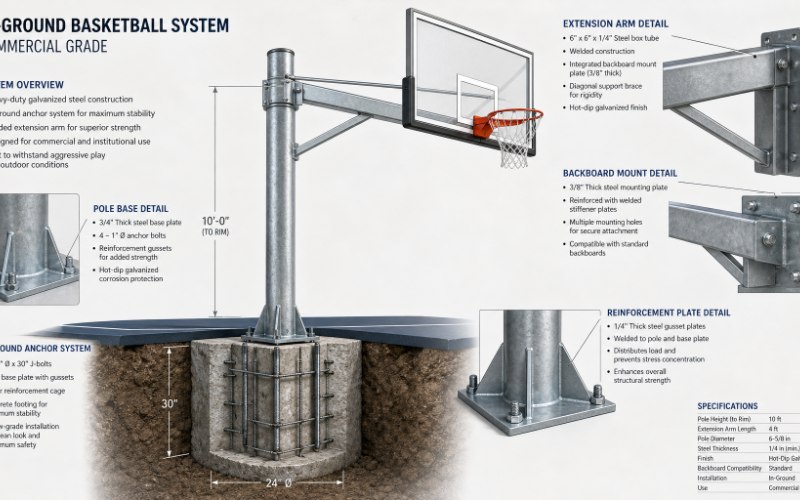
- Steel Gauge and Material: Commercial-grade poles are typically constructed from heavy-gauge steel (e.g., 5-gauge, 7-gauge, or 11-gauge square or round steel tubing). The thicker the gauge, the stronger and more stable the system. Hot-dip galvanization or powder coating is essential for outdoor systems to prevent rust and corrosion.
- Mounting Type:
- In-Ground: Offers maximum stability and permanence. Requires digging a foundation and anchoring the pole directly into concrete. Ideal for dedicated outdoor courts.
- Portable: Features a heavy base (filled with sand or water) for mobility. Suitable for multi-purpose indoor facilities or temporary outdoor use. Stability varies significantly by base size and weight; commercial-grade portables are substantial.
- Wall-Mounted: Attaches directly to a sturdy wall, freeing up floor space. Excellent for gymnasiums with limited space or for adding hoops to existing structures.
- Ceiling-Mounted: Retractable systems that lower from the ceiling, ideal for multi-sport gymnasiums where basketball hoops need to be stored away. Requires significant structural engineering and professional installation.
- Anchoring Systems: For in-ground models, anchor kits are used to secure the pole. These are typically robust steel plates embedded in concrete, allowing for precise leveling and potential future removal/relocation of the upper pole assembly.
Navigating Different Basketball Hoop Sizes for Various Applications
The optimal basketball hoop configuration is highly dependent on its intended application and target user group. System integrators must consider these specific requirements.
Regulation Sizes for Professional & Collegiate Play
- FIBA/NBA/NCAA Standards: All require a standard 10-foot rim height and 18-inch rim diameter. Backboards are typically 72″ x 42″ (1.83m x 1.07m) tempered glass, often with a minimum 4-foot setback.
- System Type: Usually ceiling-mounted or heavy-duty portable systems for arena versatility. In-ground fixed systems are less common in major arenas due to multi-sport requirements.
- Key Consideration: Emphasis on optimal rebound, stability under high impact, precise height adjustment (for retractable systems), and strict adherence to official rules.
School & Community Center Hoops: Balancing Durability and Adjustability
- Versatility is Key: These facilities often serve a wide range of ages and skill levels, necessitating adjustable height systems (typically from 7 feet to 10 feet).
- Common Backboard Sizes: 60″ x 36″ or 54″ x 36″ acrylic or polycarbonate backboards are popular choices for their balance of performance and durability. Tempered glass is also used in high school gyms.
- System Type: Wall-mounted and ceiling-mounted systems are prevalent in indoor gyms for space efficiency. In-ground systems are common for outdoor school courts. Portable systems are used for auxiliary courts or temporary setups.
- Key Consideration: Robust construction to withstand heavy use, vandal resistance (for outdoor public courts), ease of height adjustment, and compliance with institutional safety guidelines.
Youth & Recreational Systems: Promoting Skill Development and Accessibility
- Adjustable Height is Paramount: For very young children (e.g., elementary school age), lower rim heights (6-8 feet) are crucial for fostering skill development and enjoyment.
- Backboard Size: Often smaller backboards (e.g., 48″ x 32″) made of durable polycarbonate are suitable, though standard 54″ or 60″ backboards on adjustable systems are also common to grow with players.
- System Type: Portable systems are popular for youth programs due to their flexibility. Smaller-scale in-ground or wall-mounted systems with dedicated youth adjustment features can also be specified.
- Key Consideration: Emphasis on safety features (e.g., padding, stable base), simple and secure height adjustment, and materials that can endure extensive play by less experienced users.
Residential vs. Commercial Grade: Structural Differences
- Residential Hoops: Typically feature thinner gauge steel poles, smaller backboards (often acrylic or polycarbonate), simpler adjustment mechanisms, and less substantial anchoring. Designed for lighter, infrequent use by families.
- Commercial-Grade Hoops: Distinguished by heavy-gauge steel construction (poles, arms, and rims), larger and more robust backboards (tempered glass or heavy acrylic), advanced rust/corrosion protection, and secure, often tamper-resistant, adjustment and mounting systems. Engineered for high-frequency, high-impact use by multiple users and to withstand harsh weather conditions in outdoor settings.
- B2B Implications: For system integrators, always specify commercial or institutional grade equipment. Residential-grade systems will quickly degrade, become unstable, and pose safety risks in a public or commercial setting, leading to costly replacements and potential liability.
Key Factors for System Integrators in Selecting Basketball Hoops
Making an informed decision involves evaluating several key criteria beyond just size.
Intended User Age and Skill Level
This is the primary driver for adjustable height systems. Younger children benefit from lower hoops (e.g., 6-8 ft) for fundamental skill development, while older youth and adults require the standard 10 ft height. High-skill players benefit from tempered glass backboards and robust breakaway rims.
Available Court Space and Layout
Consider the total area, indoor vs. outdoor setting, and proximity to walls or other structures. This will determine if an in-ground, portable, wall-mounted, or ceiling-mounted system is most feasible and safe. Adequate setback from the pole is crucial.
Installation Type: In-Ground, Wall-Mounted, Portable, or Ceiling-Mounted
- In-Ground: Permanent, maximum stability, ideal for dedicated outdoor courts. Requires professional concrete work.
- Portable: Flexible, can be moved. Commercial-grade units are very heavy and stable but still require secure storage and careful handling. Good for multi-purpose areas.
- Wall-Mounted: Space-saving, permanent fixture. Requires strong wall structure and professional anchoring. Ideal for gymnasiums.
- Ceiling-Mounted: Ultimate space utilization and versatility for multi-sport gyms. Requires significant overhead structural support and complex installation, often integrated into facility design.
Material Durability and Weather Resistance
For outdoor installations, weather-resistant materials (galvanized steel, powder coating, acrylic/polycarbonate backboards) are essential to prevent rust, fading, and deterioration. Indoor systems still require durable materials to withstand constant impact.
Safety Standards and Certifications (ASTM, FIBA, NCAA Compliance)
Ensure chosen equipment meets local, national, and international safety standards. Look for certifications like ASTM (American Society for Testing and Materials) for general safety, and FIBA (International Basketball Federation) or NCAA (National Collegiate Athletic Association) for competitive play standards. This minimizes liability and ensures player protection.
Adjustability Features for Versatility
For multi-use facilities, look for robust, easy-to-use, and tamper-resistant height adjustment mechanisms. Screw-jack, crank, or pneumatic assist systems are common for commercial products.
Basketball Hoop System Comparison for B2B Applications
| Feature / System Type | In-Ground Hoops | Portable Hoops (Commercial Grade) | Wall-Mounted Hoops | Ceiling-Mounted Hoops |
| Typical Backboard Sizes | 54″x36″ to 72″x42″ | 54″x36″ to 72″x42″ | 54″x36″ to 72″x42″ | 60″x42″ to 72″x42″ |
| Backboard Materials | Acrylic, Polycarbonate, Tempered Glass | Acrylic, Polycarbonate, Tempered Glass | Acrylic, Polycarbonate, Tempered Glass | Tempered Glass, Acrylic |
| Rim Height Adjustment | Common (7.5ft-10ft) | Common (7.5ft-10ft) | Common (7.5ft-10ft) | Common (via winch/motor) |
| Setback/Overhang Range | 2ft to 6ft (fixed pole) | 2ft to 5ft (base size dependent) | 2ft to 6ft (fixed bracket) | Highly variable, often 4ft+ |
| Stability & Durability | Excellent (Permanent Installation) | Very Good (Heavy Base) | Excellent (Structural Wall Anchor) | Excellent (Integrated into Building Structure) |
| Ideal Application | Dedicated Outdoor Courts, Parks, Schools | Multi-Sport Gyms, Temporary Courts | Gymnasiums, Indoor/Outdoor Wall Space | Multi-Sport Arenas, Gymnasiums |
| Installation Complexity | Moderate (Concrete Footing) | Low (Assembly, Base Filling) | Moderate (Wall Reinforcement) | High (Structural Integration, Electrical) |
| Space Efficiency | Good (No base obstruction) | Moderate (Large base footprint) | Excellent (Frees floor space) | Excellent (Retracts overhead) |
Customization Options and Project-Specific Solutions
EVERGRANDSPORT understands that B2B projects often have unique requirements. We offer extensive customization options to meet specific facility designs, branding needs, or regulatory demands. This includes:
Custom Backboard Graphics: Add school logos, sponsor branding, or team insignia.
Powder Coat Colors: Match existing facility aesthetics or brand guidelines.
Specialty Padding: Custom colors and designs for backboard and pole padding to enhance safety and visual appeal.
Unique Setback Requirements: Engineering solutions for non-standard court layouts or architectural constraints.
Compliance Modifications: Adapting systems to meet specific local building codes or international sports federation standards beyond common certifications.
EVERGRANDSPORT: Your Partner in Superior Basketball Systems
At EVERGRANDSPORT, we are committed to being the global manufacturing partner of choice for commercial-grade basketball hoop systems. Our deep expertise in design, engineering, and manufacturing ensures that every product we supply meets the highest standards of quality, safety, and performance. We work closely with system integrators, distributors, schools, and municipalities worldwide to provide tailored solutions for every project, from concept to installation.Choosing the right basketball hoop system involves a meticulous evaluation of technical specifications, intended use, and long-term value. Partner with EVERGRANDSPORT to leverage our industry knowledge and extensive product range to make the optimal selection for your next sports facility project. Contact us today for a consultation or to request a detailed quote for your commercial basketball equipment needs.
Frequently Asked Questions (FAQ)
The standard basketball rim height is 10 feet (3.05 meters) from the playing surface to the top of the rim. This height is consistent across professional, collegiate, high school, and most adult recreational basketball leagues globally.
For outdoor commercial courts, acrylic or polycarbonate backboards are generally recommended. They offer excellent durability, weather resistance, and impact strength, making them highly resistant to vandalism and environmental wear compared to tempered glass, which is more suited for indoor professional environments.
The setback distance (overhang) is very important for player safety. It refers to the distance from the support pole or wall to the front of the backboard. A greater setback reduces the chance of players colliding with the support structure during aggressive play, thereby enhancing safety. For competitive play, a minimum of 4 feet is often recommended or required.
No, it is strongly advised against using residential-grade basketball hoops for schools or community centers. Commercial and institutional settings experience significantly higher usage and more aggressive play, requiring much more robust construction, heavier-gauge materials, and enhanced safety features that residential hoops lack. Using inappropriate equipment will lead to rapid wear, safety hazards, and increased long-term costs.