As a system integrator, school administrator, sports facility manager, or municipality procurement officer, selecting the right basketball hoop system is a critical decision that impacts player safety, product longevity, and overall project success. This comprehensive guide from EVERGRANDSPORT, a leading global manufacturer, provides the essential insights needed to navigate the complexities of commercial-grade basketball hoop procurement. We’ll delve into the technical specifications, material considerations, safety standards, and installation requirements to ensure you make an informed investment that delivers lasting value.
Key Takeaways for System Integrators
- Assess Project Needs First: Determine intended use (indoor/outdoor, competition/recreational), user age, and budget before selecting hoop type.
- Prioritize Durability & Safety: Choose high-grade materials (tempered glass, heavy-gauge steel, durable powder coating) and ensure compliance with international safety standards (ASTM, EN-1270, NFHS, NCAA).
- Understand Hoop Types: Differentiate between portable, in-ground, and wall-mounted systems based on flexibility, stability, and space constraints.
- Focus on Key Components: Evaluate backboard material, rim break-away mechanism, pole construction, and base stability for long-term performance.
- Consider Adjustability: Select height adjustment mechanisms that are easy to operate, secure, and suitable for the target age range.
- Plan for Installation: Proper installation is crucial for safety and system longevity; factor in site assessment and professional services.
- Seek Customization: Leverage customization options for branding and aesthetic integration with your facility.
- Partner with an Experienced Manufacturer: Choose a supplier like EVERGRANDPORT with a proven track record in B2B supply, quality assurance, and global logistics.
Why a Strategic Approach to Basketball Hoop Procurement is Crucial for System Integrators?
For system integrators and large-scale buyers, basketball hoops are not merely sporting equipment; they are long-term assets that represent a significant investment in a facility’s infrastructure. A strategic procurement approach ensures that the chosen equipment meets stringent quality, safety, and performance criteria, directly impacting user experience, maintenance costs, and liability. Missteps can lead to premature wear, safety hazards, and costly replacements, undermining the integrity of your project and client satisfaction. Focusing on durable materials, adherence to international standards, and ease of maintenance from the outset provides a superior return on investment.
What are the Primary Types of Basketball Hoops for Commercial Applications?
Selecting the correct type of basketball hoop is foundational to any commercial or institutional project. Each type offers distinct advantages and is suited for specific environments and usage patterns.
Portable Basketball Hoops: Flexibility and Mobility
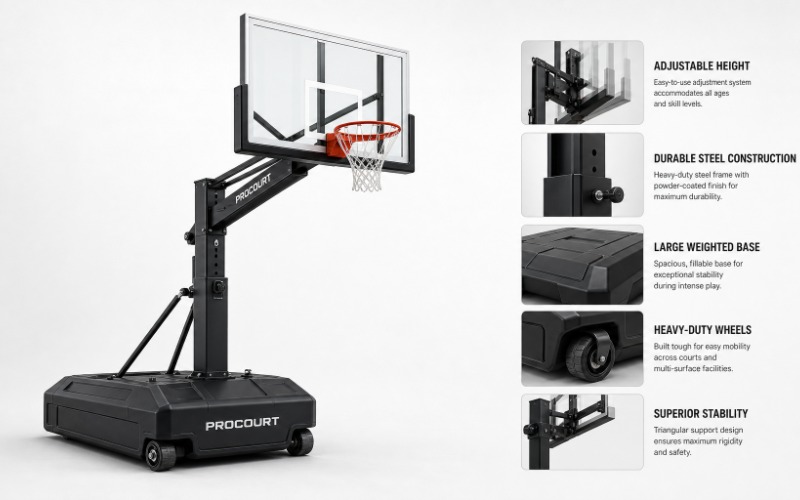
Portable basketball hoops are characterized by a wheeled base that allows for relocation. They are ideal for multi-purpose gymnasiums, community centers, and outdoor courts where permanent fixtures are not desired or feasible. While offering unparalleled flexibility, their stability is dependent on the ballast in the base (typically sand or water).
- Pros: High mobility, no permanent installation required, adjustable height, often more budget-friendly upfront.
- Cons: Less stable than in-ground or wall-mounted systems, requires proper base weighting, potential for tip-over if misused.
- Ideal Use Cases: School gyms needing flexible court layouts, community recreation centers, events, residential common areas.
In-Ground Basketball Hoops: Superior Stability and Performance
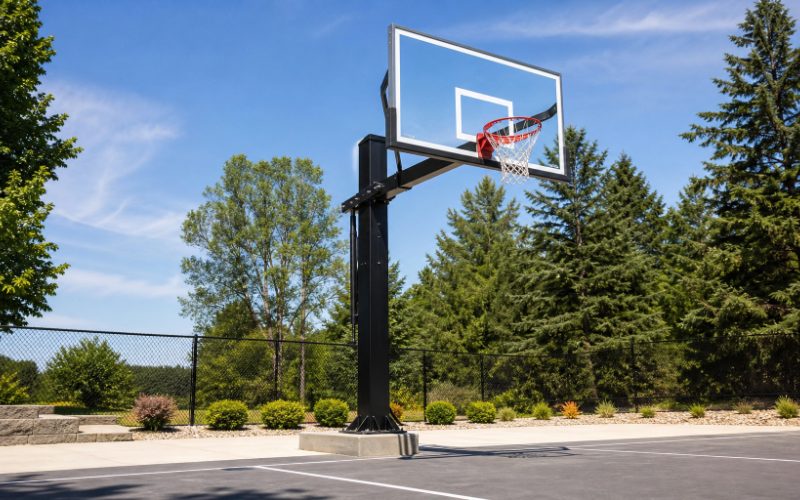
In-ground basketball hoops are permanently installed into a concrete foundation, providing the highest level of stability, rigidity, and authentic play experience. They are the preferred choice for dedicated outdoor courts, competitive play, and situations where maximum durability and minimal maintenance are paramount.
- Pros: Exceptional stability and rigidity, professional play feel, long lifespan, minimal risk of tipping, withstands harsh weather.
- Cons: Permanent installation, requires concrete pouring and curing, not movable, generally higher initial cost and installation complexity.
- Ideal Use Cases: School athletic courts, municipal parks, dedicated outdoor recreation facilities, competitive training grounds.
Wall-Mounted Basketball Hoops: Space-Saving Solutions
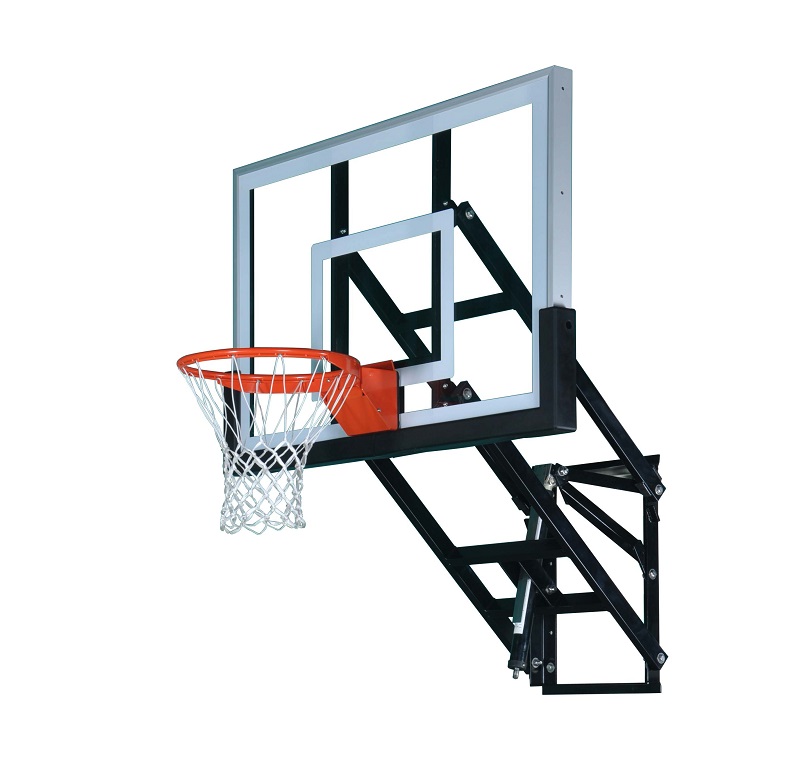
Wall-mounted systems are affixed directly to a sturdy wall, making them an excellent choice for indoor gyms, smaller facilities, or areas where floor space is limited. They offer good stability and can often be adjusted for height. Care must be taken to ensure the supporting wall structure can handle the dynamic loads.
- Pros: Space-efficient, very stable once installed, no floor obstructions, often adjustable.
- Cons: Requires a robust supporting wall, permanent fixture, less flexible than portable units, installation can be complex.
- Ideal Use Cases: Indoor school gymnasiums, multi-purpose community halls, practice courts with limited floor space.
Key Components of a Commercial Basketball Hoop System
Understanding the individual components and their material specifications is crucial for assessing the overall quality and suitability of a basketball hoop system for commercial applications.
Backboard Material and Size: Performance and Durability
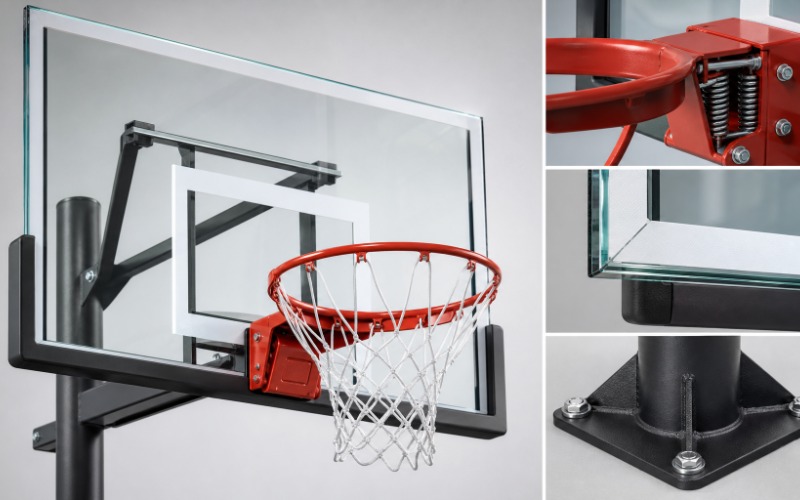
- Tempered Glass: Offers the best rebound and professional play experience. Highly durable but susceptible to shattering under extreme impact. Standard for competitive play. Thickness typically 1/2″ (12mm) to 3/8″ (10mm).
- Acrylic: A transparent, shatter-resistant plastic. Provides good rebound, lighter than glass, and more economical. Common for high-end residential and institutional use where glass isn’t feasible. Thickness typically 3/8″ (10mm) to 1/4″ (6mm).
- Polycarbonate: Extremely durable and virtually unbreakable, making it ideal for high-traffic, outdoor, or unsupervised public courts where vandalism or heavy abuse is a concern. Rebound is not as true as glass or acrylic. Thickness typically 1/4″ (6mm) to 3/16″ (5mm).
- Steel/Aluminum: Often used for solid backboards in extremely rugged outdoor or park settings. Maximum durability, but poor rebound characteristics.
Standard Sizes: Official NBA/NCAA regulation size is 72″ x 42″ (183cm x 107cm). Youth or recreational courts may use 60″ x 36″ (152cm x 91cm) or 54″ x 32″ (137cm x 81cm).
Rim Design and Construction: Strength and Safety
- Breakaway Rims: Essential for safety and equipment longevity in commercial settings. They flex downwards under player weight or forceful dunks, reducing stress on the backboard and preventing player injury. Spring-loaded mechanisms ensure the rim returns to its original position. Single spring and double spring designs are common.
- Fixed Rims: More economical but not recommended for facilities expecting dunking or heavy use due to increased risk of injury and equipment damage.
- Material: Heavy-gauge steel, typically 5/8″ (16mm) or 3/4″ (19mm) solid steel, powder-coated for weather resistance.
Pole/Support Structure: Stability and Longevity
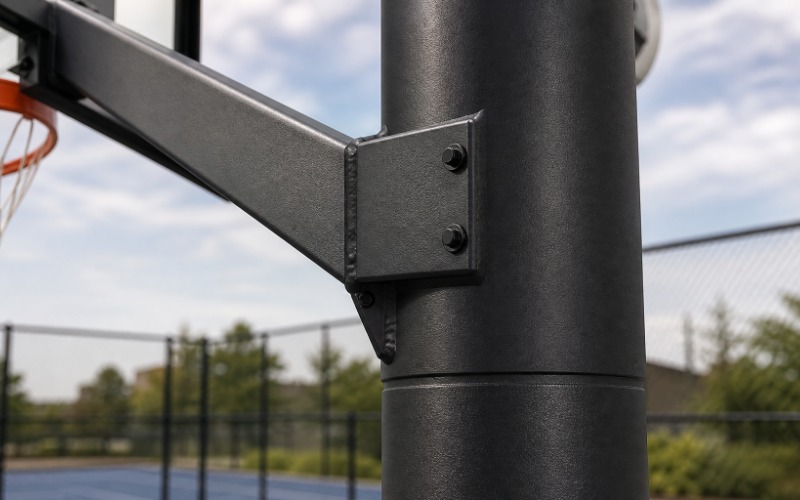
- Material: Heavy-gauge steel tubing is standard. Square or round poles are common. The thicker the gauge and larger the diameter/width, the greater the stability.
- Coating: Outdoor systems require robust corrosion protection. Powder coating is superior to standard paint, offering enhanced chip and rust resistance. Hot-dip galvanization provides the highest level of corrosion protection for extreme outdoor conditions.
- Offset: The distance the backboard extends from the pole or wall mount. A larger offset (e.g., 3-5 feet for competitive play) increases safety by allowing players to play under the basket without hitting the pole.
Base/Mounting System: Secure Foundation
- Portable Bases: Constructed from heavy-duty molded plastic or steel, filled with sand or water. Larger capacities offer greater stability. Wheels must be robust for frequent movement.
- In-Ground Anchor Systems: A steel anchor kit is cemented directly into the ground, providing a stable mounting point for the pole. This allows for pole removal if needed, but keeps the anchor permanent.
- Wall Mounts: Heavy-duty steel brackets designed to distribute weight across a structural wall. Requires professional assessment of wall integrity.
Understanding Adjustability and Height Mechanisms
Adjustable height systems are invaluable for facilities catering to diverse age groups and skill levels, from youth leagues to adult competitions. Key mechanisms include:
- Crank Systems: Manual crank mechanisms allow for smooth, precise height adjustments, typically from 7.5 feet to 10 feet. Durable and reliable.
- Hydraulic/Pneumatic Systems: Offer effortless one-person adjustment, often found in high-end portable and some in-ground systems. Premium option.
- Spring-Assist Systems: Utilize springs to counterbalance the weight of the backboard, making manual adjustments easier.
- Telescoping/Pin-Lock Systems: Simpler, more economical adjustments where the pole sections slide and lock into place with a pin. Less precise but very robust.
What Safety Standards and Certifications Should Be Prioritized?
Adherence to safety standards is paramount in commercial sports equipment. For basketball hoops, look for compliance with the following:
- ASTM F2360 (Standard Consumer Safety Performance Specification for Basketball Systems): A comprehensive standard covering stability, structural integrity, and player safety for consumer systems.
- EN-1270 (European Standard for Basketball Equipment – Functional and Safety Requirements, Test Methods): Mandatory for basketball equipment sold in Europe, covering structural strength, stability, and safety during use.
- NFHS (National Federation of State High School Associations): Guidelines for high school sports equipment in the USA, ensuring fair play and safety.
- NCAA (National Collegiate Athletic Association): Regulations for collegiate-level basketball equipment, setting high standards for performance and safety.
- ISO Certifications: Manufacturers with ISO 9001 (Quality Management) and ISO 14001 (Environmental Management) demonstrate commitment to quality and responsible production.
Material Selection for Durability and Weather Resistance
The operational environment dictates material choices:
- Outdoor Systems: Demand maximum weather resistance. Look for hot-dip galvanized steel or heavy-gauge steel with marine-grade powder coating for poles and frames. Stainless steel hardware is preferred. Polycarbonate backboards are often favored for extreme durability, though tempered glass with proper rust-proof framing can also be used.
- Indoor Systems: While less exposed to elements, durability is still key. Powder-coated steel is standard. Tempered glass or acrylic backboards are common, offering superior rebound for competitive play.
Installation Considerations for Optimal Performance and Safety
- Site Assessment: Crucial for determining the best hoop type and ensuring structural integrity of the mounting surface (ground or wall).
- Foundation Depth & Size (In-Ground): Must comply with manufacturer specifications and local building codes to prevent leaning or instability. Adequate concrete volume and curing time are essential.
- Wall Structure (Wall-Mounted): Verify that the wall can support the dynamic load of the backboard and player interaction. Often requires reinforcement.
- Professional Installation: Highly recommended for all commercial-grade systems to ensure safety, performance, and adherence to warranties.
- Clearance and Spacing: Ensure adequate clearance around the court for player safety and to meet official game regulations.
Customization Options and Branding Opportunities
Many manufacturers offer customization to integrate the hoops seamlessly into your facility’s aesthetic or branding:
- Backboard Graphics: Custom logos, school mascots, or facility branding can be applied to backboards.
- Pole/Frame Colors: Powder coating can be matched to specific color palettes.
- Padding: Custom padding colors and branding for poles and backboards enhance safety and visual appeal.
Comprehensive Comparison: Portable vs. In-Ground vs. Wall-Mounted Hoops
To aid system integrators in their decision-making, here’s a detailed technical comparison of the three main basketball hoop types:
| Feature | Portable Hoop System | In-Ground Hoop System | Wall-Mounted Hoop System |
|---|---|---|---|
| Installation Type | Temporary, wheeled base filled with ballast (sand/water) | Permanent, steel anchor kit cemented into concrete foundation | Permanent, heavy-duty steel brackets bolted to structural wall |
| Stability & Rigidity | Moderate (dependent on base weight), some shake during play | Excellent, maximum rigidity for professional play | Excellent, very rigid if wall is sound |
| Mobility | High (can be moved for storage or multi-use courts) | None (fixed location) | None (fixed location) |
| Space Requirement | Requires storage space when not in use, larger footprint due to base | Minimal footprint at ground level | Utilizes wall space, frees up floor space |
| Recommended Use | Multi-purpose gyms, recreational, community centers, events | Dedicated outdoor courts, competitive play, schools, parks | Indoor gyms, smaller facilities, practice courts |
| Backboard Offset (from pole/wall) | Typically 2-4 feet | Often 3-5 feet (or more for competition) | Variable, can be customized, typically 2-6 feet |
| Weather Resistance (Outdoor) | Base plastics/steel, powder-coated pole. Consider winter storage. | Hot-dip galvanized or marine-grade powder-coated steel for maximum longevity. | Not typically an outdoor solution unless explicitly designed and treated. |
| Typical Cost (System Only) | Mid-range | High-range (plus significant installation cost) | Mid to high-range (plus significant installation cost) |
| Maintenance | Check ballast, wheel condition, pole/backboard integrity. | Inspect pole/backboard for wear, rim integrity. Minimal. | Inspect wall mounts, pole/backboard for wear, rim integrity. Minimal. |
Making the Right Investment: A Checklist for B2B Buyers
- Define Project Scope: What is the intended primary use (recreational, training, competition)? Indoor or outdoor? Target age groups?
- Budget Allocation: Factor in not just the hoop system cost, but also shipping, customs, installation, and long-term maintenance.
- Compliance & Safety: Verify all relevant safety standards (ASTM, EN-1270, NFHS, NCAA) and certifications. Request documentation.
- Material Specifications: Confirm backboard material/thickness, rim type (breakaway essential), pole gauge, and coating (especially for outdoor).
- Adjustability Requirements: Determine the desired height range and adjustment mechanism durability.
- Warranty & Support: Understand the manufacturer’s warranty, spare parts availability, and technical support.
- Logistics & Lead Times: For international procurement, clarify shipping methods, delivery schedules, and customs procedures.
- Manufacturer Reputation: Choose a reputable, experienced B2B manufacturer like EVERGRANDSPORT with a track record of quality and reliability.
FAQ
For outdoor public courts, polycarbonate backboards are highly recommended due to their extreme durability and resistance to shattering and vandalism. While tempered glass offers superior rebound, its fragility can be a liability in unsupervised public settings. Acrylic is a good compromise for moderate-use outdoor courts.
A breakaway rim is critically important for school and community gyms. It significantly enhances player safety by preventing injuries from forceful dunks and protects the backboard and support structure from damage, extending the lifespan of the entire system. Fixed rims are not recommended for any facility where dunking may occur.
The “offset” refers to the distance the front of the backboard extends away from the main support pole or wall. A larger offset creates more safe playing space under the basket, allowing players to drive and shoot without colliding with the pole, thereby reducing injury risk and improving the overall play experience, especially in competitive settings.
Yes, EVERGRANDSPORT specializes in customized sports equipment solutions. We can work with system integrators and project developers to meet specific design, branding, material, and sizing requirements for large-scale projects, ensuring our products integrate perfectly with your facility’s needs and aesthetic.
Partner with EVERGRANDSPORT: Your Trusted Global Manufacturer
Choosing EVERGRANDSPORT means partnering with a leader in professional sports equipment manufacturing. We combine cutting-edge design, high-quality materials, and rigorous safety standards to deliver basketball hoop systems that meet the demanding requirements of B2B clients worldwide. From concept to container, our team is dedicated to providing superior products, customized solutions, and seamless logistics for your next sports facility project. Contact us today for a comprehensive quote or to discuss your specific project needs.