The right soccer goal is the one that matches the game format, field, users, installation conditions, and maintenance plan. A goal for a school training area does not need the same configuration as a full-size match goal, an indoor futsal goal, or a public field installation.
Start by answering five questions: Who will use the goal? Where will it be installed? What size does the league or activity require? Will it be moved? How will it be anchored, inspected, and stored? These answers are more useful than choosing a product from a keyword such as “professional” or “heavy-duty.”
Choose the goal size for the game format
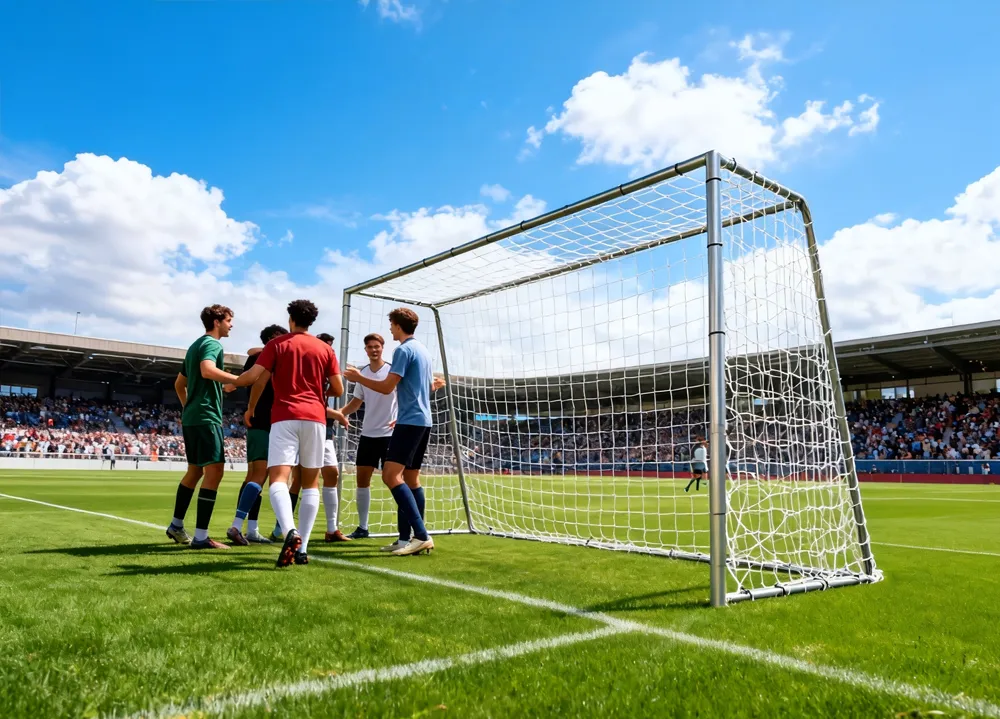
Size should be the first specification to confirm. For an 11-a-side match, the International Football Association Board states in Law 1 that the goalposts are 7.32 metres apart and the crossbar is 2.44 metres above the ground. These are standard full-size match dimensions, but they do not automatically apply to youth training, small-sided games, futsal, or home practice.
Before ordering, check the rules of the competition, school program, club, or governing body. A training goal may be intentionally smaller so players can work on finishing, passing, or goalkeeper movement. A youth program may also use different dimensions for different age groups. If the goal is for a multi-use facility, measure the usable playing area, run-off space, storage route, and ceiling height before selecting a size.
For indoor futsal, use the futsal rules and the venue’s court plan. A full-size outdoor goal may be too large for an indoor court, difficult to store, or unsuitable for the intended small-sided format.
Match the frame material to the environment
Frame material of the soccer goals affects weight, handling, rigidity, corrosion protection, and cost. The main comparison is usually between aluminum and steel, but the material name alone is not enough to judge a goal.
Aluminum soccer goals
Aluminum is often considered for portable goals because a lower frame weight can make transport and setup easier. This can suit schools, clubs, academies, parks with shared equipment, and training areas that change layout. Buyers should still check the profile, joints, base design, wheel arrangement, and anchoring method. A lighter frame is not automatically suitable for every field or level of use.
Ask the supplier for the alloy or profile information, connection details, finish specification, and recommended use. If the product is described as rust-resistant or suitable for outdoor use, request the supporting material or test information rather than treating a marketing keyword as proof.
Steel soccer goals
Steel is commonly considered where a heavier structure, impact resistance, or a more permanent installation is important. It can be a practical option for schools, parks, clubs, and other high-use environments, but the extra weight affects transport, installation, and storage.
Outdoor steel goals also need a clear corrosion-control plan. Ask what coating or treatment is used, which parts are most exposed, how damaged surfaces should be repaired, and how often the goal should be inspected. A painted or coated frame still needs routine checks, especially around joints, welds, fasteners, sockets, and areas where water can collect.
The useful comparison is not “aluminum versus steel” in isolation. Compare the complete system, including the frame profile, base, anchors, net supports, hardware, finish, replacement parts, and intended use.
Decide between portable and fixed installation
Portable soccer goals
Portable goals work well when a field is shared, equipment must be stored after use, or training activities move between locations. They can support warm-ups, shooting drills, youth practice, and small-sided sessions. Before buying, check the complete movement and storage process:
- Can staff move the goal safely along the actual surface?
- Are the wheels, handles, or lifting points suitable for the route?
- Will the goal fit through doors, gates, and storage areas?
- How is it secured during play and when it is parked?
- Can the frame and net be inspected without dismantling the entire unit?
Portable does not mean risk-free. A portable goal still needs the anchoring or counterweight method specified by the manufacturer and used according to the installation instructions. Never rely on the goal’s weight alone when the supplier requires additional securing.
Fixed or semi-permanent soccer goals
Fixed goals may suit a dedicated pitch, public sports field, stadium training area, or school ground where the layout will remain stable. They can reduce repeated setup work, but the purchase must include a proper plan for sockets, anchors, foundations, drainage, access, and future replacement.
Semi-permanent systems can be useful when the frame is removed seasonally but the ground hardware remains in place. Confirm how the goal is installed, how the sockets are protected when the frame is removed, and whether local ground or construction requirements apply.
Check stability and anchoring before appearance
Stability is a system property, not a visual feature. Review the base depth, rear frame, ground sockets, anchors, ballast requirements, and connection hardware together. The correct method depends on the goal design, playing surface, wind exposure, usage, and local instructions.
Ask for an installation drawing that shows the goal in its intended position. It should help the buyer understand the anchoring points, required clearances, assembly sequence, and inspection locations. If the goal is for a public field or school, assign responsibility for installation and periodic inspection before delivery.
Do not publish or accept an unsupported safety guarantee. A responsible product page should explain the required securing method and direct the buyer to model-specific instructions.
Evaluate the net, supports, and hardware
The net affects ball retention, setup time, replacement cost, and the appearance of the goal. Check the net dimensions, attachment method, mesh specification, UV or weather claims, and availability of replacements. Also inspect the net supports and clips. A durable net is less useful if the attachment points are difficult to replace.
Review the hardware list as well. Fasteners, corner joints, wheels, sockets, protective caps, and replacement parts can determine how easily the goal is maintained over several seasons. For a school or club buying several units, ask whether spare parts can be matched by model and supplied in the expected quantity.
Compare total cost, not only the purchase price
The quoted unit price is only one part of the project cost. A portable goal may require ballast, wheels, protective storage, or additional staff time for movement. A fixed goal may require foundations, ground sockets, drainage work, installation labor, and later replacement of exposed hardware. Indoor systems may also need structural review or lifting equipment during installation.
Ask the supplier to separate the main equipment, accessories, installation items, spare parts, packaging, and delivery charges. Confirm what is included in the quotation and what must be provided locally. This makes offers easier to compare and helps prevent a low initial price from becoming a more expensive installation later. For multi-goal projects, request the same specification format for every model so differences in size, material, anchoring, and service parts are visible.
Select a goal for the actual users
Different users need different priorities:
| Use case | Selection priorities |
|---|---|
| Full-size match field | Competition dimensions, field layout, anchoring, net support, and inspection |
| School or youth training | Correct age-group size, easy supervision, storage, and adjustable training layouts |
| Soccer academy | Repeated setup, replacement parts, training formats, and transport between sessions |
| Indoor futsal venue | Futsal dimensions, compact storage, floor protection, and indoor assembly conditions |
| Public park | Permanent installation, corrosion inspection, anchoring, vandalism exposure, and maintenance access |
| Backyard practice | Appropriate smaller size, simple setup, safe storage, and a realistic movement route |
This is a starting point rather than a universal ranking. The right choice still depends on the site and the specific product documentation.
Request a complete quotation package
When contacting a manufacturer, send a short specification brief instead of only writing “I need a soccer goal.” Include:
- Game format and required goal dimensions.
- Indoor or outdoor location.
- Field surface and installation area.
- Number of goals and expected users.
- Portable, semi-permanent, or fixed preference.
- Frame material and finish requirements, if already defined.
- Net size, color, attachment, and replacement expectations.
- Anchoring, foundation, socket, or ballast requirements.
- Storage, movement, packaging, and delivery constraints.
- Required drawings, certificates, inspection instructions, and spare parts.
Final checklist
Before placing an order, confirm the competition size, field measurements, frame and finish specifications, anchoring method, net details, storage route, maintenance plan, replacement parts, and installation responsibility. Then compare model-specific drawings and documents, not just category names.
The best soccer goal is not the one with the longest list of claims. It is the one that fits the users, the field, and the way the facility will install, operate, inspect, and store it. A clear project brief makes that decision easier for the buyer and gives the manufacturer the information needed to recommend a suitable configuration.