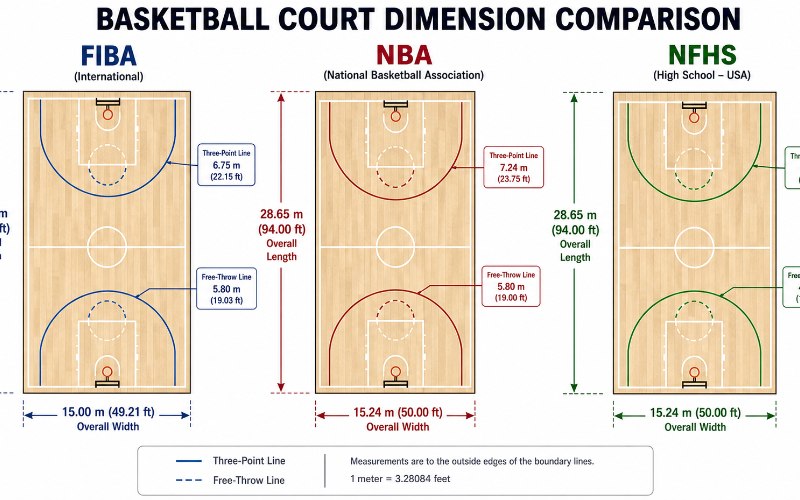
Regulation basketball courts are generally 94 feet (28.65 m) long and 50 feet (15.24 m) wide in the NBA and NCAA. FIBA courts are 28 meters by 15 meters, or about 91.9 feet by 49.2 feet. NFHS high school courts are commonly 84 feet by 50 feet. The hoop height is 10 feet (3.05 m) at every senior level. The three-point line distance is the main measurement that changes by rule set.
This guide compares full court and half court dimensions used by FIBA, NBA, NCAA, and NFHS. It also shows how court size should influence your basketball hoop selection.
Why does court size matter when planning a basketball facility?
Your available area determines whether you can build a full court, a half court, or a smaller training space. Accurate dimensions help you order the right hoop and marking materials the first time.
Even a small measurement error can cause problems. Players need predictable foul lines and three-point arcs. Facility owners need safe run-off around the court.
What are the official full court dimensions?
The table below compares the main full court sizes and key line distances. Use it as a starting point for your site plan.
| Rule set | Length | Width | Three-point line distance from hoop | Free-throw line distance from backboard | Hoop height |
|---|---|---|---|---|---|
| FIBA | 28 m (91.9 ft) | 15 m (49.2 ft) | 6.75 m (22 ft 1.75 in) | 4.6 m (15.1 ft) | 3.05 m (10 ft) |
| NBA | 94 ft (28.65 m) | 50 ft (15.24 m) | 23.75 ft (7.24 m) | 15 ft (4.57 m) | 10 ft (3.05 m) |
| NCAA | 94 ft (28.65 m) | 50 ft (15.24 m) | 22 ft 1.75 in (6.75 m) | 15 ft (4.57 m) | 10 ft (3.05 m) |
| NFHS high school | 84 ft (25.6 m) | 50 ft (15.24 m) | 19 ft 9 in (6.02 m) | 15 ft (4.57 m) | 10 ft (3.05 m) |
Always verify the current version of each rulebook before construction. FIBA publishes the FIBA Official Basketball Rules. The NBA lists court specifications in its playing rules. U.S. high school facilities can check the NFHS Basketball Rule Book.
College basketball uses a 94-by-50-foot court in most NCAA venues. Because NCAA three-point distances and lane dimensions may change, confirm your exact league or facility requirements when ordering paint and equipment.
What is the regulation size of a half court?
A half court places one basket at one end and uses the midcourt line as its back boundary. The playing area is half the length of the full court.
- NBA / NCAA half court: 47 ft by 50 ft.
- FIBA half court: 14 m by 15 m, or about 45.9 ft by 49.2 ft.
- NFHS high school half court: 42 ft by 50 ft.
When designing a half court, do not forget the run-off zone. For a home driveway, the court lines may need to be smaller than regulation so the hoop base can sit safely.
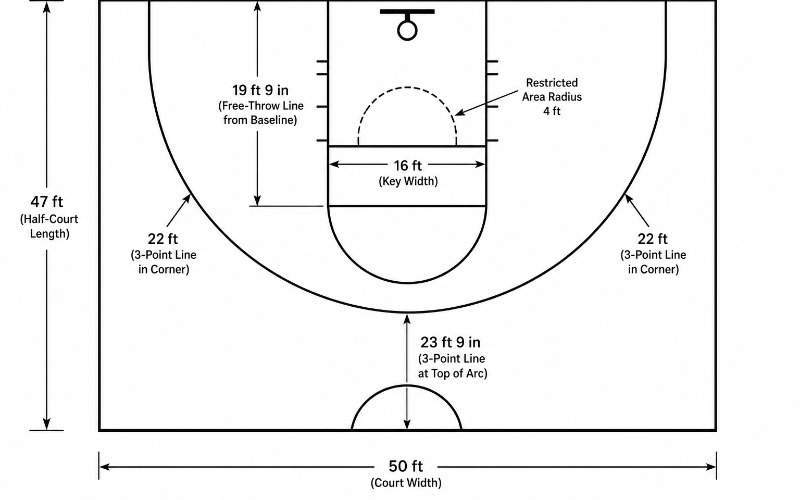
What are the key measured lines on a basketball court?
Measure these lines carefully because they affect shot distances and equipment placement.
Hoop height
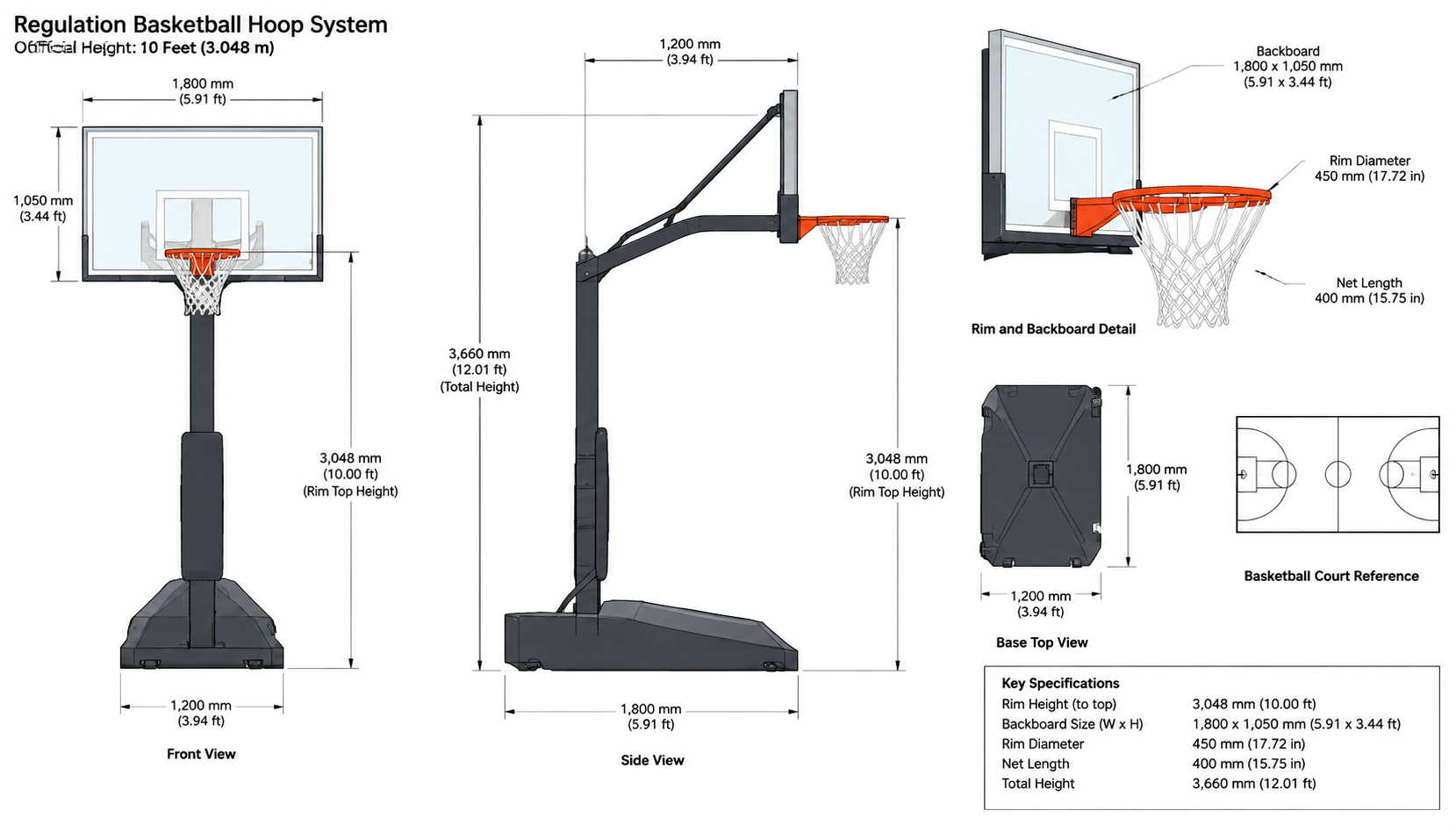
The rim height is 10 feet (3.05 m) in FIBA, NBA, NCAA, and NFHS senior competition. Most adult hoops are set at this height.
Free-throw line
The free-throw line is 15 feet (4.57 m) from the backboard in the NBA, NCAA, and NFHS. In FIBA, it is about 4.6 m (15.1 ft) from the backboard. The backboard usually sits 1.2 m (4 ft) from the baseline.
Three-point line
This arc creates different, game-changing distances at each level. The NBA uses the longest line at 23.75 ft from the hoop, with a shorter 22 ft corner distance. FIBA and current NCAA rules use approximately 6.75 m (22 ft 1.75 in). NFHS high school courts use 19 ft 9 in.
Because three-point distances are easy to misread, have a professional surveyor or a qualified court contractor mark them.
What basketball terms should I know before planning a court?
Use these terms when talking to contractors or suppliers.
- Baseline: the end line behind each basket.
- Sideline: the long boundary along the court.
- Centerline/midcourt line: the line that divides the court in half.
- Free-throw line: where a player shoots a foul shot.
- Three-point line: the arc that separates a two-point shot from a three-point shot.
- Key or paint: the marked area under the basket, which can vary by rule set.
How does court size affect basketball hoop selection?
After you finalize your dimensions, choose a hoop system that matches the court type and site.
| Court scenario | Recommended basketball hoop type |
|---|---|
| Full-court school gym or community center | In-ground basketball hoop for fixed stability and durability. |
| Half-court outdoor park or playground | In-ground or heavy-duty portable hoop, depending on site soil and usage. |
| Multi-purpose indoor facility | Portable basketball hoop so the same floor can host other sports. |
| Youth training or residential driveway | Portable hoop with adjustable height for different player ages. |
For a full-size regulation court, an in-ground system is usually more stable and secure. Portable hoops are better for multi-use spaces because they can be moved out of the way. Both options are available from EVERGRAND Sport for school and facility projects.
Before ordering, measure the distance from the mounting point to the back boundary. This prevents the hoop base or pole from blocking the required playing area. You can also read our basketball hoop guide for more equipment advice.
How do I measure my space for a basketball court?
Follow these steps to get a usable site plan.
- Measure the full length and width of the available space.
- Choose the primary rule set: FIBA, NBA, NCAA, or NFHS.
- Mark the baseline and centerline with chalk or string.
- Verify the corners form 90-degree angles.
- Clear a buffer zone beyond the court lines for player run-off.
- Confirm the indoor ceiling height is high enough for a 10-foot rim.
- Select an in-ground or portable hoop system.
For more planning content, visit the basketball basics category.
What are common court sizing mistakes to avoid?
- Assuming all full courts are 94 by 50 feet.
- Ignoring run-off space outside the court lines.
- Choosing a portable hoop before measuring its base footprint.
- Forgetting to check ceiling height before installing a 10-foot rim.
- Painting lines before selecting the primary rule set.
Avoid these mistakes by keeping a clear record of your chosen standard and the exact playing boundary.
What should I include in a court-planning checklist?
Use this checklist before you commit to equipment or paint.
- Measure the full length and width of the available space.
- Choose the primary rule set: FIBA, NBA, NCAA, or NFHS.
- Decide if you need a full court or a half court.
- Calculate the playing area and leave run-off space outside the lines.
- Confirm hoop height and whether you need an adjustable model.
- Select an in-ground or portable hoop system.
- Review backboard and rim dimensions with our basketball hoop dimensions guide.
If you want a printable project checklist, request one from the EVERGRAND Sport team along with your quote.
Frequently asked questions about basketball court dimensions
How can EVERGRAND Sport help you plan a basketball court?
EVERGRAND Sport supplies basketball hoops and sports facility equipment to schools, clubs, distributors, and projects worldwide. We can help you select the correct system based on your court measurements and target standard.
Bring your site dimensions and rule set to our sales team. We will recommend a portable or in-ground hoop that fits your project. Contact us to request a quote or ask for more details.