BLUF: The regulation basketball hoop height for all adult, collegiate, and secondary school competitions stands at exactly 10 feet. This standard measurement translates directly to 3.05 meters or precisely 120 inches from the playing court surface. Younger athletes require lower rim elevations between 6 and 9 feet to develop proper shooting biomechanics. Institutional planners must evaluate user demographics before purchasing fixed or variable systems for community sports facilities. Selecting the correct hoop elevation prevents player injury and ensures consistent skill progression across all athletic programs.
How High Is a Basketball Hoop?
Basketball enthusiasts frequently ask how tall is a basketball hoop when planning new court construction projects. Dr. James Naismith established this iconic ten-foot height standard in December 1891 at Springfield College. He mounted two peach baskets directly to the indoor running track railing inside the gymnasium facility. That suspended gallery railing happened to measure precisely ten feet above the finished hardwood floor surface. Every major basketball association around the world still respects this historical benchmark for competitive athletic play. Consequently, the 10-foot measurement remains standard across the NBA, WNBA, FIBA, NCAA, and NFHS organizations.
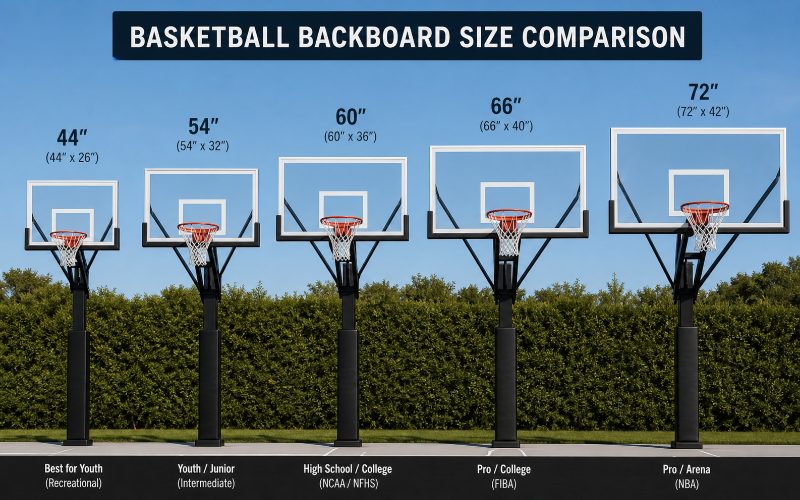
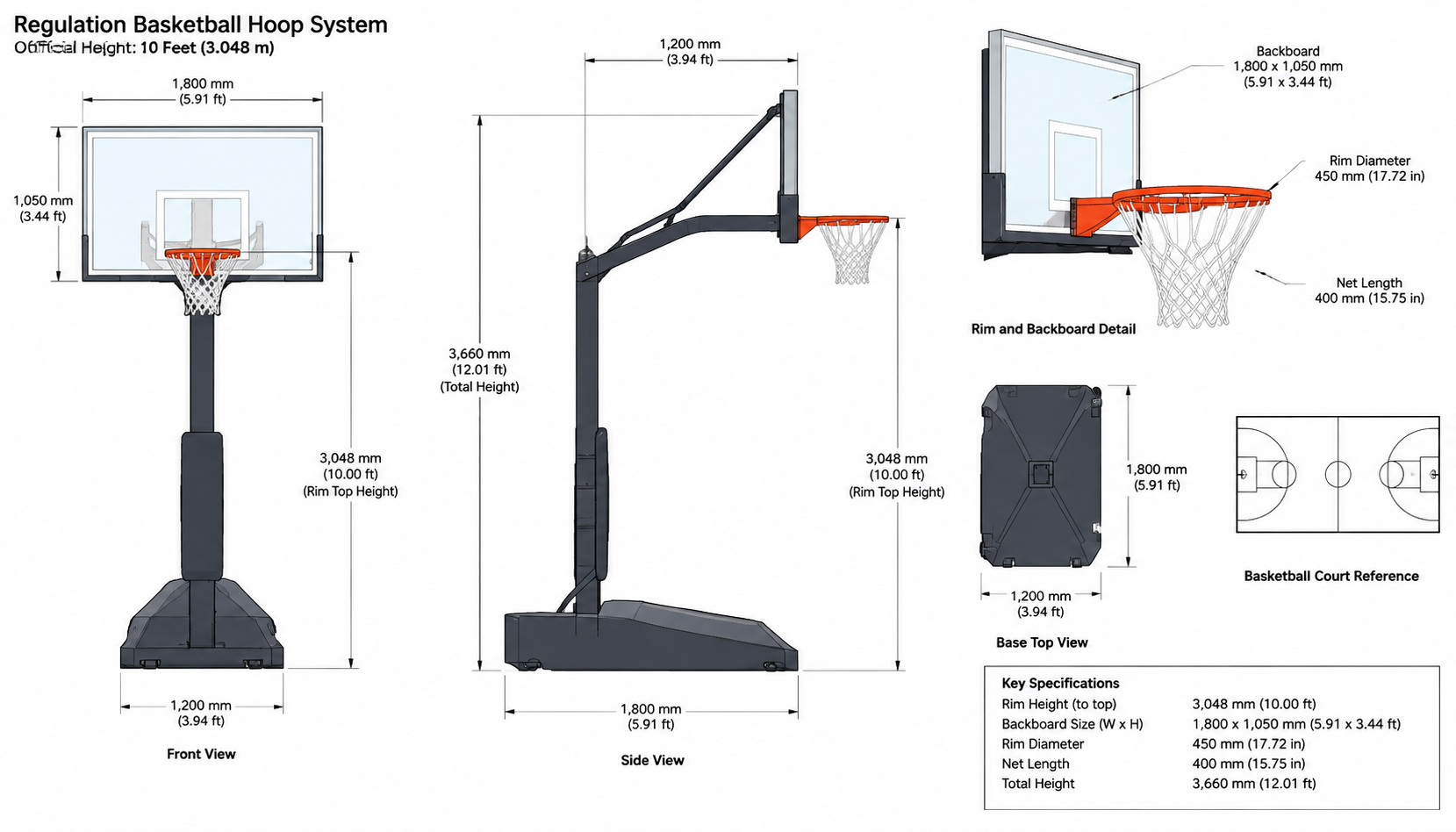
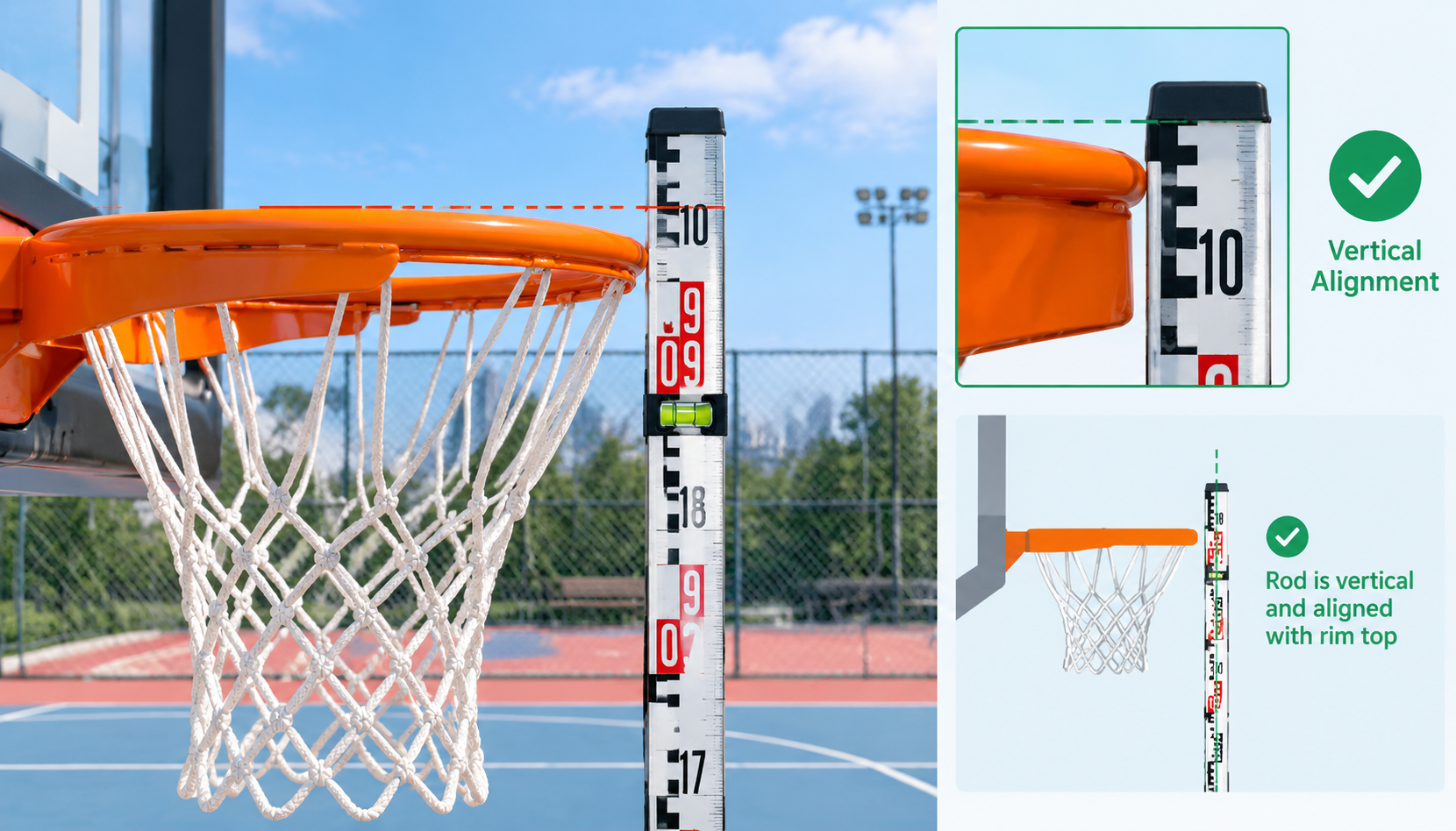
The official basketball hoop height is measured from the top horizontal edge of the steel rim. Technicians measure straight down along a plumb line directly to the finished court surface underneath. Installers must never measure to the bottom net hooks or the lower edge of the backboard. Furthermore, the standard steel rim features an inside diameter of eighteen inches across all competitive levels. The rim attaches directly to a rigid rectangular backboard measuring seventy-two inches wide by forty-two inches high.
Regulation Heights by Age and Playing Level
Younger athletes lack the upper body strength required to launch regulation basketballs toward standard ten-foot rims. Forcing young children onto adult rims inevitably leads to severe mechanical flaws in their shooting form. Youth players typically push the basketball with two hands from their chest to gain needed elevation. This compensatory physical motion creates improper muscle memory that takes coaches several years to correct later. Lowering the hoop height allows developing athletes to master proper elbow alignment and balanced release follow-throughs.
Youth athletic organizations have established clear developmental milestones for basketball hoop height across various age brackets. Children between kindergarten and second grade perform best on hoops set between six and eight feet. Third and fourth grade students generally transition up to an eight-foot rim during structured league play. Fifth grade athletes commonly advance to nine-foot rims before reaching middle school competitive basketball programs. By seventh grade, all student athletes should compete exclusively on standard ten-foot regulation basketball hoops. The following structured reference table summarizes these age-specific height recommendations alongside suitable basketball ball sizes.
| Age Bracket | School Grade | Rim Height (Imperial) | Rim Height (Metric) | Recommended Ball Size | Developmental Objective |
|---|---|---|---|---|---|
| Ages 5–7 | Kindergarten–2nd | 6 to 8 Feet | 1.83 m – 2.44 m | Size 3 (22.0″) or Size 4 (25.5″) | Hand-eye coordination and basic shooting motion |
| Ages 8–9 | 3rd–4th Grade | 8 Feet | 2.44 m | Size 5 (27.5″) | Arc trajectory development and passing mechanics |
| Ages 10–11 | 5th–6th Grade | 9 Feet | 2.74 m | Size 6 (28.5″) | Standard shooting form and free-throw routine |
| Ages 12+ | 7th Grade & Above | 10 Feet | 3.05 m | Size 6 (Women) / Size 7 (Men) | Official regulation play and competitive mechanics |
School districts must select equipment that accommodates multiple grade levels within shared gymnasium spaces and facilities. Elementary schools often host community youth leagues alongside standard physical education classes throughout the school year. Installing fixed ten-foot goals in primary school facilities restricts physical education programming for younger developmental age groups. Consequently, educational facility directors increasingly specify versatile hardware that adjusts across several standardized vertical positions. These flexible systems support proper skill development while preserving tournament capability for older competitive student athletes.
Adjustable vs Fixed-Height Basketball Hoops
Institutional buyers must choose between adjustable basketball systems and dedicated fixed-height athletic installations for their facilities. Adjustable basketball hoops provide exceptional operational flexibility for multi-use recreation centers and public school districts. These versatile systems typically allow operators to modify rim elevation between seven and ten feet effortlessly. In contrast, fixed-height goals deliver unmatched structural stability for demanding high school and collegiate competition venues. Fixed systems eliminate moving mechanical components that might otherwise suffer wear or require seasonal height re-calibration.
Commercial adjustable systems rely on specialized mechanical actuators to facilitate rapid and safe height modifications. Premium configurations utilize sealed pneumatic gas springs or internal worm-gear screw jacks operated by removable handles. These enclosed mechanisms prevent unauthorized tampering while ensuring smooth operation by certified maintenance technicians and coaches. Budget residential hoops often use external spring-loaded levers that can present severe pinch hazards to children. Commercial facility managers must always specify enclosed, vandal-resistant adjustment hardware for unsupervised public park environments.
| System Attribute | Adjustable Basketball Hoops | Fixed-Height Basketball Hoops | Procurement Guidance |
|---|---|---|---|
| Elevation Versatility | Infinitely adjustable from 7.0′ to 10.0′ | Locked permanently at official 10.0′ | Choose adjustable systems for multi-age demographic facilities. |
| Structural Rigidity | Moderate to high depending on actuator design | Maximum rigidity with zero moving hinge play | Specify fixed units for varsity competition and streetball parks. |
| Vandal Resistance | Requires lockable crank or keyed access panel | Extremely high with welded gussets and braces | Fixed systems resist aggressive public park tampering best. |
| Maintenance Demands | Periodic actuator lubrication and pin inspection | Minimal maintenance beyond routine anchor torque checks | Fixed units significantly reduce facility labor maintenance costs. |
| Ideal Application | Primary schools, recreation centers, training gyms | High school gyms, universities, municipal parks | Match hardware format directly to facility programmatic scope. |
Facility managers should evaluate the primary user demographic before finalizing their sports equipment purchase orders. Dedicated varsity competition courts require fixed ten-foot units to eliminate any potential play in the structure. Community parks and elementary school blacktops achieve significantly higher utilization rates with commercial-grade adjustable systems. Furthermore, adjustable units enable facility directors to host youth camps without investing in separate portable goalposts. Selecting the correct system design optimizes long-term facility return on investment while maintaining user athletic safety.
How to Measure Rim Height Correctly
Accurate height measurement requires precise alignment from the finished court surface to the top rim plane. Contractors frequently make catastrophic measurement errors by measuring before applying final asphalt or acrylic surfacing layers. A two-inch court resurfacing overlay will unintentionally reduce your finished rim height to nine feet ten inches. Therefore, installation crews must always account for final surface finishes during concrete footer and anchor placement. Using proper surveying tools ensures your finished basketball goal meets all sanctioned regulatory height standards perfectly.
Step-by-Step Rim Height Measurement Protocol
Follow this systematic five-step protocol to verify your basketball hoop height accurately before opening the court. First, inspect the ground surface directly below the rim to establish a clean and stable reference point. Second, position a rigid surveyor measuring rod or digital laser distance meter vertically on that surface. Third, align the measuring device plumb using a spirit level to prevent diagonal measurement distance inflation. Fourth, measure straight to the top horizontal edge of the rim metal rather than the net hooks. Fifth, repeat this precise measurement across both sides of the rim to confirm lateral rim levelness.
Overhang deflection represents another critical variable that frequently alters basketball hoop height during competitive athletic gameplay. Overhang refers to the horizontal distance extending from the support post face to the backboard plane. Heavy cantilevered extension arms can experience minute structural sagging under the weight of glass backboard assemblies. Consequently, quality installation crews verify rim height only after installing all backboard glass, padding, and rims. Periodic re-checking of rim elevation maintains competitive court integrity across changing seasonal weather and thermal conditions.
Basketball Hoop Height Selection Checklist
Selecting the ideal basketball system requires thorough analysis of physical site conditions and athletic program objectives. Procurement specialists should collaborate closely with engineering teams and athletic coaches before releasing technical equipment tenders. Overlooking structural setback clearances or anchor foundation engineering can cause substantial installation delays and financial overruns. Similarly, choosing inappropriate adjustment mechanisms may expose public facility operators to unwanted liability and maintenance headaches. Review the following engineering and procurement checklist to ensure your facility selects the optimal basketball system.
- Target Demographic and Age Spectrum: Determine whether primary users require junior rim elevations or fixed ten-foot regulation heights.
- Subterranean Foundation Footing Depth: Verify concrete footing depth meets regional frost lines to prevent structural frost heave displacement.
- Overhang Clearance and Safe Runoff: Maintain a minimum clearance of four feet between baseline court lines and post structures.
- Backboard Material Composition: Specify tempered safety glass for indoor competition or heavy-gauge perforated steel for municipal parks.
- Elevation Mechanism Tamper Proofing: Confirm that height adjustment mechanisms feature lockable keyed covers or removable adjustment handles.
- Corrosion Resistance Treatment: Demand hot-dip galvanizing and multi-stage powder coating for outdoor systems located in humid climates.
- Breakaway Impact Release Specifications: [NEEDS SME INPUT] for specific institutional breakaway rim release torque load ratings.
Structural foundation specifications must reflect local soil bearing capacity and municipal frost depth building code requirements. In northern climates, subterranean concrete pier footings must extend well below the established regional frost penetration level. Frost heave can shift the anchor assembly upwards and distort vertical rim height by several critical inches. Furthermore, coastal installations require marine-grade hot-dip galvanized steel tubing to prevent catastrophic structural corrosion over time. Proper engineering due diligence ensures structural longevity and unwavering vertical accuracy for decades of intensive community play.
Facility Maintenance and Elevation Calibration Protocols
Routine operational maintenance safeguards equipment longevity and guarantees that hoop elevation remains within official sanctioned tolerances. Heavy rim dunking and seasonal ground settlement gradually force extension arms out of their initial calibrated alignment. Facility staff should conduct bi-annual elevation audits using calibrated digital laser meters on every installed court. In addition, technicians must inspect all pivot bushings, extension arm pins, and tension cables for physical wear. Applying high-temperature synthetic grease to internal worm-gears guarantees effortless manual height adjustments throughout freezing winter months.
Breakaway rims require specialized dynamic calibration to ensure consistent rebound performance and athlete finger safety. Institutional breakaway mechanisms feature internal spring assemblies designed to absorb extreme downward dunking impact loads safely. Over time, heavy cyclic loading can weaken these springs and cause visible front-lip rim sag below ten feet. Maintenance personnel should verify rim tensioning nuts annually to maintain official resistance levels across every backboard. Replacing tired spring mechanisms restores factory rigidity and prevents inaccurate shooting angles for competitive varsity basketball players.
Frequently Asked Questions About Basketball Hoop Height
What is the regulation basketball hoop height for high school?
The official regulation basketball hoop height for both junior high and high school play is ten feet. The National Federation of State High School Associations mandates this uniform dimension across all member school districts. Both boys and girls varsity programs utilize the exact same ten-foot rim height in interscholastic sports competition. However, girls basketball utilizes a slightly smaller size six basketball to match physiological female grip ergonomics. Court dimensions and free throw distances also mirror collegiate standards to foster seamless player athletic development.
At what age should kids start shooting on a 10-foot rim?
Young athletes should generally begin practicing on standard ten-foot rims around age eleven or twelve years old. This transition typically coincides with entry into seventh grade or standard middle school interscholastic athletic team leagues. Coaches should monitor individual physical maturity before transitioning younger players to standard ten-foot regulation rim heights. If a player alters their natural shooting mechanics to reach the rim, lower the goal temporarily. Gradual elevation increases over several months build shoulder strength while reinforcing fundamentally sound shot release mechanics.
How does court resurfacing affect basketball hoop height?
Resurfacing an existing outdoor asphalt court with acrylic layers or modular plastic tiles reduces vertical rim height. Standard asphalt overlays add between one and two inches of new material directly over the old slab. This added thickness lowers the effective distance between the court floor and the top of the rim. With fixed-height systems, contractors must excavate around the base or adjust anchor nuts to restore ten feet. Adjustable basketball systems eliminate this costly issue by allowing rapid manual height re-calibration following paving work.
Can portable basketball hoops maintain accurate regulation height under heavy play?
Commercial-grade portable basketball goals can maintain accurate regulation height when properly counterweighted with dedicated concrete ballasts. However, low-cost residential portable hoops often sag significantly due to structural flex in thin two-piece pole sections. Institutional portables feature massive structural steel bases and mechanical locking pins that prevent unintended vertical height drift. Facility operators must inspect portable base ballast weights regularly to ensure total structural stability during dunking play. For permanent athletic facilities, in-ground systems remain the gold standard for long-term dimensional accuracy and rigidity.
Procure Commercial Basketball Systems from EVERGRAND Sport
EVERGRAND Sport is a premier global manufacturer and exporter of professional sports facility equipment and basketball systems. We engineer heavy-duty in-ground, wall-mounted, and adjustable basketball hoops for schools, municipal recreation departments, and commercial contractors. Our factory utilizes automated laser cutting, robotic welding, and specialized electrostatic powder coating lines for maximum weather resistance. Whether you need custom OEM production runs or standard container-load wholesale orders, our engineering team delivers precision solutions. Contact our technical sales division today to request factory-direct quotations, structural engineering drawings, and comprehensive product catalogs.