Bottom Line Up Front (BLUF): A commercial soccer goal purchase involves far more than simply buying an aluminum or steel crossbar. Institutional buyers must evaluate the complete system price, which combines structural frames, net assemblies, safety anchors, and freight charges. Total project costs regularly exceed bare equipment estimates when contractors omit installation, replacement hardware, and lifecycle maintenance fees. Comparing quotes requires procurement teams to isolate manufacturing specifications, freight classifications, and regional compliance factors before awarding contracts. This procurement guide details line-item budget variables and provides a verified quote review checklist for sports facility managers.
How Much Does a Soccer Goal Cost?
Procurement teams often begin their budgeting process by reviewing catalog list prices for standalone goal frames. However, standard commercial equipment pricing ranges significantly depending on material profiles, engineering specifications, and intended competition tiers. Base manufacturing costs reflect the raw alloy grade, extrusion diameter, wall thickness, and specialized surface powder coating. Facility operators who evaluate solely the sticker price routinely encounter substantial financial variances during field delivery and site commissioning. A realistic budget framework requires calculating the total cost of ownership across the entire planned operational lifecycle.
Total procurement costs divide into distinct direct manufacturing expenses, site logistics, installation labor, and ongoing maintenance obligations. Direct hardware expenses include the structural crossbars, upright posts, backdrops, net tie-off systems, and ground sleeves. Freight and local logistics frequently represent an unexpectedly high percentage of overall spending due to bulky, non-standard shipping dimensions. Site preparation, professional concrete footings, and safety anchoring protocols add further labor expenditures during installation. Accurate initial quote assessments isolate these modular components so project managers can compare competing vendor proposals directly.
Project managers should expect unit pricing to vary dramatically between entry-level training models and professional stadium systems. High-volume municipal orders typically benefit from bulk container shipping economies, reducing the landed cost per pitch significantly. Conversely, single-field municipal retrofits face premium freight tariffs and localized contractor rates that inflate single-unit installation budgets. Regional ground conditions and prevailing wind load engineering standards also determine whether ground sleeves or specialized internal counterweights are necessary. Comprehensive quote requests must therefore state exact site parameters to establish an accurate baseline commercial price.
Goal, Net, Anchoring, Installation, and Delivery Costs Compared
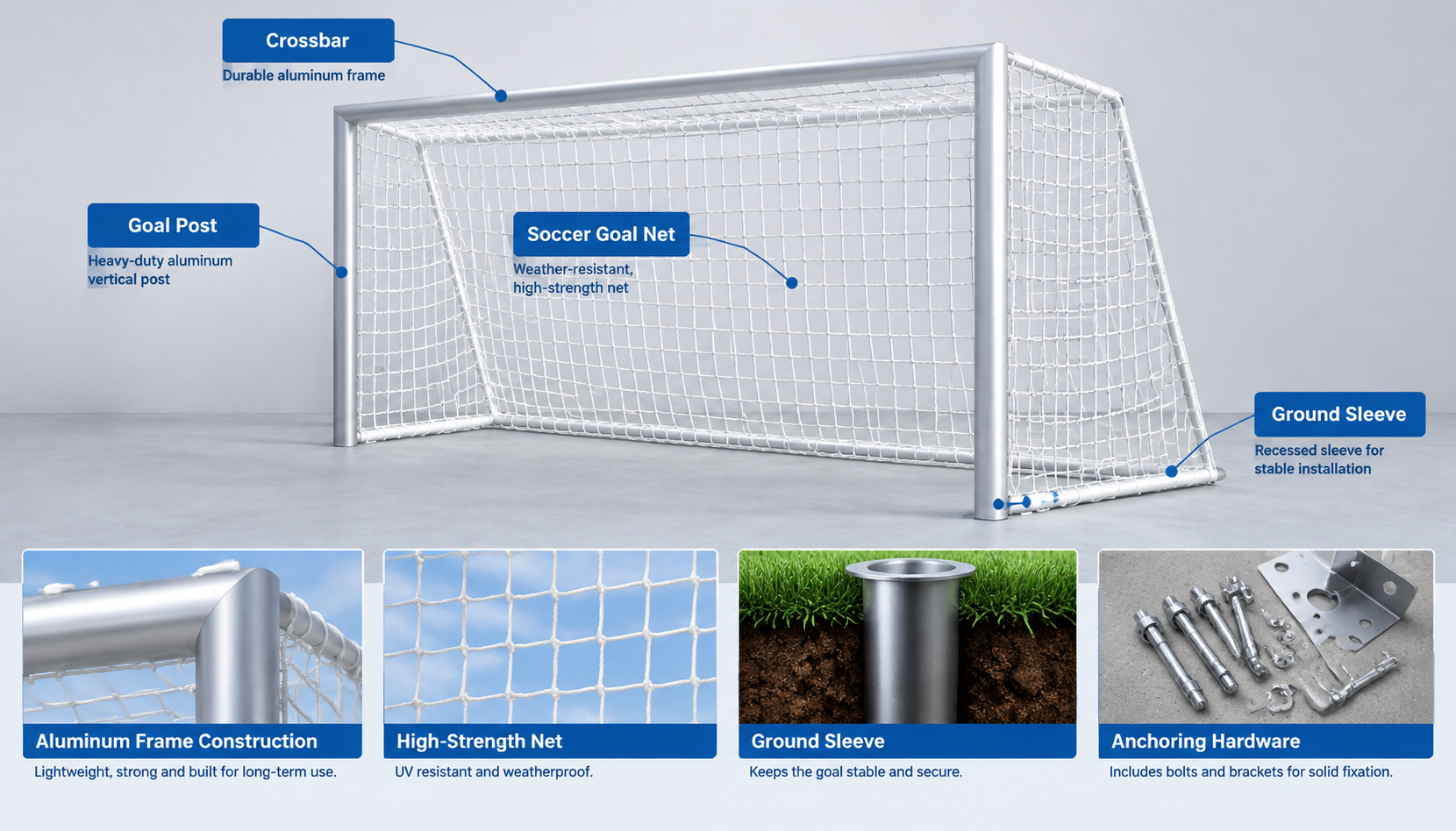
Evaluating an industrial equipment quote requires breaking down the total lump sum into five essential cost categories. Suppliers often disguise transportation overheads or omit critical hardware assemblies to present artificially lower initial base bids. When facilities evaluate line items independently, they protect themselves against unexpected change orders during facility construction. Each core component carries specific material standards, safety implications, and long-term durability metrics that directly impact total costs. The following structural breakdown outlines how each major component drives the final project expenditure.
The primary goal frame represents the largest single equipment investment within your facility procurement package. Heavy-duty extruded aluminum profiles provide optimal structural rigidity while resisting ambient surface oxidation and outdoor atmospheric corrosion. In contrast, steel goal construction offers robust impact resistance at lower raw material costs but adds substantial deadweight. Frame costs escalate when projects demand custom powder coating finishes, reinforced internal corner castings, and recessed net attachment channels. Specifying precise profile geometries, such as elliptical or round posts, ensures compliance with governing tournament regulations.
A commercial soccer goal net must endure repetitive ball impacts, ultraviolet solar degradation, and fluctuating seasonal temperatures. Net specifications depend directly on twine diameter, braided filament composition, knot construction, and standard geometric mesh dimensions. Thicker braided high-density polyethylene or polypropylene nets naturally command higher wholesale price points than lightweight twisted cords. Specialized accessories, including internal channel fasteners, heavy-duty bungee loops, and ground-locking tension bars, add minor initial component costs. Investing in superior net density prevents premature fraying, seasonal sagging, and frequent mid-season field maintenance calls.
Safety anchoring represents a non-negotiable budget component that directly governs player safety and institutional facility liability. In-ground soccer goals demand dedicated ground sleeves set into precisely engineered subterranean concrete foundation footings. Portable units require engineered counterbalance systems, which include fillable ballast chambers, steel drop-in weights, or integrated ground stakes. Anchoring costs increase significantly when operating on sand-filled synthetic turf fields where standard ground augers cannot penetrate. Facilities must allocate sufficient budget for certified anchor mechanisms that meet regional structural stability standards .
Freight logistics for oversized athletic equipment frequently surprise procurement officers unfamiliar with commercial freight classification rules. Goal crossbars and uprights span long structural dimensions that do not fit into standard shipping container pallet configurations. Carriers assess dedicated long-length surcharges, liftgate delivery fees, and scheduled residential or rural site drop-off penalties. Consolidating goal shipments into full flatbed freight or standardized ocean containers substantially lowers per-unit transport expenses. Project tenders must always specify Incoterms and clarify whether unloading equipment is the contractor’s or client’s responsibility.
On-site installation costs fluctuate according to field access, contractor labor availability, and prevailing soil structural integrity. Subsurface excavation for concrete footings requires specialized auger machinery, concrete mixing, cure management, and laser-guided alignment checks. Portable configurations reduce civil excavation costs but require technician assembly hours for wheel kits, brackets, and counterbalance integration. Rushed municipal construction schedules or difficult all-weather turf access can trigger elevated subcontracting labor rates. Transparent project quotes must separate factory manufacturing lead times from final on-pitch contractor installation phases.
| Procurement Component | Cost Influence Factor | Primary Technical Variables | Quote Review Priority |
|---|---|---|---|
| Goal Frame Structure | High | Alloy grade, wall thickness, profile geometry, powder coating | Verify mill certs and structural profiles |
| Soccer Goal Net | Low to Moderate | Twine thickness (3mm–5mm), braided HDPE, UV stabilizers | Confirm mesh size and clip channel type |
| Safety Anchoring | Moderate | Ground sleeves, internal ballast, counterweights | Review pull-out strength and safety compliance |
| Freight & Logistics | Moderate to High | Oversized cargo class, container loading, liftgate access | Clarify agreed Incoterms and unloading duties |
| Civil Installation | Moderate to High | Concrete volume, soil excavation, labor rates | Separate contractor scope from hardware supply |
Portable, Training, Futsal, and Permanent Goal Budget Factors
Sports facilities serve diverse sporting formats that dictate the physical engineering and structural footprint of soccer goals. Selecting the appropriate goal design requires matching performance expectations against capital expenditure limitations and operational flexibility. A community sports complex hosting multiple age divisions requires completely different equipment than a dedicated municipal tournament stadium. Procurement specialists must analyze how portable, training, futsal, and permanent goal designs influence overall financial investments. Choosing the wrong physical format introduces unnecessary replacement costs and ongoing labor inefficiencies across seasons.
A portable soccer goal provides exceptional field flexibility across shared recreational turf and multi-sport athletic centers. These units feature heavy-duty integrated flip-down transport wheels that allow groundskeepers to relocate heavy equipment safely. However, mobility features require reinforced corner joints, internal counterbalance ballast weights, and robust wheel axle bearings. The added engineering complexity elevates the initial factory manufacturing cost compared to basic fixed-position frames. Facilities must also budget for ongoing wheel maintenance, tire replacement, and turf-friendly wide-tread wheel upgrades.
Permanent and semi-permanent in-ground soccer goals provide unmatched structural stability for dedicated single-sport competition pitches. These systems eliminate ongoing counterbalance inspection routines and prevent unauthorized movement by recreational facility visitors. Ground sleeve systems permit seasonal removal while preserving underground foundation alignment for future athletic tournament play. The upfront capital cost focuses heavily on subterranean civil engineering, concrete footing volumes, and precision sleeve positioning. While initial ground installation demands higher trade labor, lifetime maintenance expenditures remain significantly lower than movable designs.
Facilities managing youth academies and training drills frequently procure football goals small for small-sided practice sessions. These compact goals utilize lightweight modular aluminum framing that simplifies manual field repositioning and compact off-season storage. Because these compact training units experience intensive targeted drills, corner weld joints must withstand frequent close-range ball impacts. Procurement budgets benefit from lower freight rates and reduced raw material volumes associated with smaller physical footprints. Multi-pitch complexes typically order these training frames in bulk packages to optimize manufacturing setups and container space.
Indoor sports facilities and futsal courts require specialized goal dimensions tailored to hard court gymnasium surfaces. Futsal goals feature specific three-meter by two-meter frame dimensions constructed from durable square or round metal profiles. Base frames require non-marking rubber pads or polyurethane floor protectors to prevent expensive damage to indoor hardwood. Counterweights for indoor use must avoid loose sand or liquid ballast that could leak onto court surfaces. Indoor facilities should verify that floor mounting plates comply with local sports facility building engineering codes.
Spare Parts, Storage, and Maintenance Costs to Include
Capital budgeting for athletic infrastructure often fails when planners ignore ongoing operational wear and consumable component replenishment. Outdoor sports hardware experiences continuous weathering from ultraviolet radiation, ambient moisture, acid rain, and physical impact stresses. High-traffic athletic venues must replace net ties, net cords, and wheel bearings regularly to maintain compliance standards. Omitting these recurring operational expenses forces groundskeepers to utilize uncertified improvised repairs that jeopardize participant safety. A well-constructed procurement bid accounts for complete multi-year maintenance kits during the initial equipment award.
Consumable components like the soccer goal net represent a planned recurring operating expense across institutional playing fields. High-intensity competitive matches and rigorous daily team training accelerate fiber abrasion along ground contact lines and goalpost corners. Facility directors should maintain spare netting packages, UV-stabilized clip sets, and replacement bungee fasteners in inventory. Stocking these critical spare parts directly avoids match cancellations and prevents safety violations during regional athletic audits. Procuring spare netting bundles alongside the initial goal frame order locks in wholesale pricing and matching dimensions.
Off-season storage equipment safeguards valuable municipal assets against winter weather degradation, vandalism, and unauthorized recreational misuse. Portable goal transport dollies, wall-mounted indoor storage brackets, and protective weather wraps extend the usable service lifespan. When goals remain unprotected on frozen fields throughout harsh winters, powder coatings degrade and internal metal joints corrode. Allocating capital toward dedicated transport dollies also reduces worker back injuries and lowers facility insurance liability claims. Municipal maintenance facilities should include dedicated dry storage racks within their annual athletic facility capital budgets.
Routine maintenance protocols require certified technicians to conduct structured periodic structural inspections and bolt torque verifications. Ground anchors, locking pins, weld joints, and sleeve caps require scheduled seasonal reviews to prevent sudden catastrophic failures. Facility managers must track maintenance hours, weld integrity evaluations, and touch-up corrosion treatments in structured facility logs. While basic preventative maintenance requires minimal hardware expense, failing to perform routine checks can result in severe municipal liability. Calculating annual maintenance labor hours ensures realistic budgeting across the planned five-to-ten-year equipment life cycle.
Soccer Goal Quote Comparison Checklist
Procurement officers must evaluate competing vendor proposals using a standardized scoring matrix to ensure true commercial comparability. Bids that appear exceptionally low on initial review often omit freight insurance, duty tariffs, or structural anchors. Reviewing documentation against an exhaustive commercial checklist exposes hidden line items before contracts are signed and finalized. A disciplined verification process confirms that all bidding manufacturers meet identical mechanical standards and delivery terms. Use the following structured checklist criteria to evaluate equipment proposals from prospective sports manufacturing partners.
- Frame Material Specifications: Confirm metal alloy grade, wall extrusion thickness, cross-sectional geometry, internal corner gusset reinforcements, and powder coating thickness specifications.
- Net Quality and Attachment Hardware: Verify cord thickness in millimeters, knotless versus knotted construction, high-density polymer composition, UV degradation resistance, and channel clip quantities.
- Safety Anchoring Verification: Check whether ground sleeves, subterranean caps, external counterweights, or synthetic turf anchor plates are explicitly included within the hardware package.
- Delivery Logistics & Incoterms: Clarify freight delivery classifications, port handling duties, container offloading equipment needs, destination transport insurance, and curbside delivery access limitations.
- Installation Scope Allocation: Define whether on-site foundation digging, concrete mixing, frame assembly, and alignment calibration are handled by the supplier or general contractor.
- Spare Parts and Warranty Package: Review manufacturer structural frame warranty duration, surface finish protection terms, spare hardware packages, and availability of replacement components.
Once your procurement team populates each checklist metric, assign weighted scores to clarify commercial and technical trade-offs. Suppliers who provide transparent engineering drawings, detailed material certificates, and clear warranty terms represent lower long-term project risks. Avoid vendors who provide vague single-line lump sum estimates that conceal individual freight and hardware component costs. A thorough quote comparison protects public funds, safeguards institutional budgets, and guarantees high-performance athletic equipment. Engaging professional manufacturers early in the design phase ensures seamless field installation and compliance.
Frequently Asked Questions About Soccer Goal Procurement
Why do commercial soccer goal quotes vary so widely between manufacturers?
Commercial quote variations stem from differences in raw material grades, profile wall thicknesses, and included accessories. Budget suppliers frequently quote lightweight consumer frames without safety anchors, nets, or commercial freight surcharges included. Premium manufacturers provide heavy-gauge commercial aluminum, integrated wheel assemblies, UV-rated braided netting, and structural certifications. To ensure fair evaluations, institutional buyers must normalize vendor quotes by isolating individual hardware and logistical components.
Are in-ground sleeve goals cheaper to purchase and maintain than portable goals?
In-ground sleeve goals feature lower initial hardware costs than portable units equipped with internal counterweights and wheel systems. However, in-ground systems demand higher initial civil excavation and concrete foundation labor during the on-site installation phase. Over a ten-year operational lifespan, permanent in-ground goals cost less to maintain because they lack moving wheel assemblies. Portable goals remain essential for multi-use fields despite requiring periodic wheel maintenance and counterbalance safety checks.
How often should a municipal athletic facility replace a commercial soccer goal net?
Institutional facilities typically replace competitive soccer netting every two to four years depending on field usage and weather. High-traffic tournament venues exposed to intense sunlight and continuous play experience faster tensile fiber degradation. Purchasing high-density braided netting with proven ultraviolet resistance extends service life significantly beyond economy twisted options. Conducting semi-annual tension inspections allows maintenance teams to mend minor tears before complete structural failure occurs.
What shipping details must buyers clarify to prevent unexpected freight surcharges?
Buyers must identify whether their delivery facility has a commercial loading dock, forklift equipment, or wide truck access. Commercial crossbars exceed standard freight pallet lengths, triggering specialized oversized transport fees and custom delivery scheduling requirements. Specifying clear Incoterms ensures transparency regarding which party handles port customs clearance, terminal handling, and destination offloading. Clarifying these logistical details during the initial quoting stage prevents expensive freight delay penalties at the project site.
Can facilities retrofit existing stationary goals with modern transport wheel systems?
Retrofitting existing soccer goal systems depends on the structural profile shape, ground bar design, and manufacturer engineering. Many commercial equipment suppliers offer universal clamp-on flip-over wheel mechanisms designed for standard round or elliptical bottom frames. However, adding wheels without verifying internal frame rigidity or structural balance can create tipping hazards during field transport. Facilities must always consult manufacturer engineering documentation before attaching third-party wheel kits to existing athletic frames.
High-performance athletic venues require durable, certified goal systems engineered to withstand intense competition and adverse outdoor environments. Contact our commercial engineering team today to review your project specifications and receive an itemized manufacturing proposal. Request a soccer goal quote directly from EVERGRAND Sport to secure transparent wholesale pricing, engineered compliance, and reliable global delivery for your facility.