
As a global leader in sports equipment manufacturing, EVERGRANDSPORT understands the critical decisions B2B buyers face when selecting basketball hoop systems. For distributors, school procurement managers, sports facility planners, and municipal contractors, the choice between portable and in-ground basketball hoops is pivotal, influencing long-term costs, operational flexibility, safety, and user experience. This comprehensive guide provides an analytical, objective, and decision-support framework to help you make an informed procurement choice.
In-ground basketball hoops offer superior stability, durability, and a professional aesthetic, making them ideal for permanent installations in high-traffic environments like schools and public parks. Portable hoops, while offering unmatched flexibility in placement and storage, are better suited for multi-purpose facilities, training areas, or locations requiring occasional use and mobility. Your decision should align with the project’s long-term vision, budget, site specifics, and user requirements.
Key Takeaways
- **Stability & Safety:** In-ground systems offer superior stability and safety due to permanent concrete anchoring, ideal for high-traffic public use. Portable units require careful ballast management for safety.
- **Durability & Lifespan:** In-ground hoops generally boast longer lifespans and greater resistance to weather and heavy use, especially those with galvanized steel and tempered glass.
- **Installation & Flexibility:** Portable hoops offer immediate, flexible placement and relocation. In-ground units require permanent site preparation and professional installation, limiting future movement.
- **Cost Considerations:** Initial cost can vary. Portable units often have lower upfront installation costs, but high-end models can rival in-ground systems. Long-term, in-ground systems may offer better ROI through reduced maintenance and replacement needs.
- **Performance & Playability:** In-ground systems, particularly those with tempered glass backboards and professional-grade breakaway rims, typically offer a more authentic and higher-performance playing experience.
- **Target Application:** Portable hoops suit multi-purpose gyms, residential courts, or temporary event use. In-ground hoops are best for dedicated outdoor courts, schools, parks, and competitive play.
Understanding the Core Differences: Portable vs. In-Ground Systems
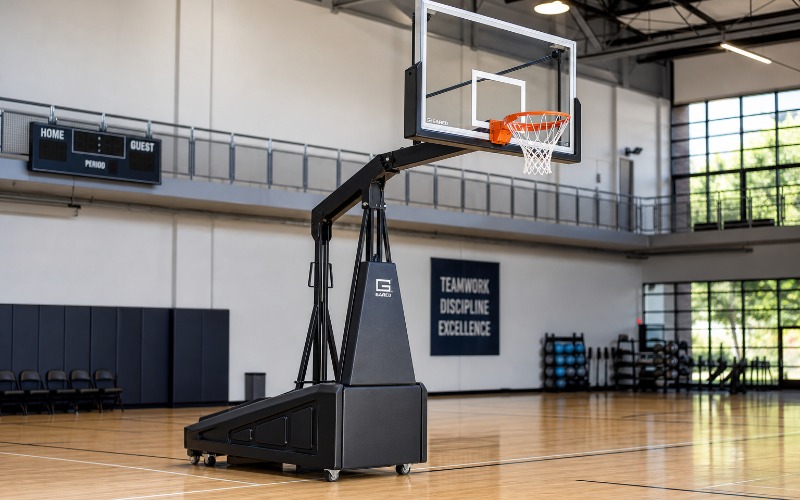
What is a Portable Basketball Hoop?
A portable basketball hoop system is characterized by a base that can be filled with water or sand for ballast, allowing the entire unit to be moved. These systems typically feature a backboard, a rim, a pole, and a wheeled base. Their primary advantage lies in their mobility and ease of setup, making them suitable for temporary courts or spaces requiring flexibility.
- **Pros**
- **Flexibility:** Easily repositioned for different events, multi-purpose facilities, or storage.
- **No Permanent Installation:** Avoids concrete work and ground penetration.
- **Lower Initial Installation Cost:** No need for professional excavation or concrete pouring.
- **Versatility:** Ideal for indoor gyms, school common areas, or community centers where courts are temporary.
- **Cons**
- **Reduced Stability:** Can be prone to tipping if not properly ballasted or if subjected to aggressive play.
- **Lower Durability:** Often built with lighter materials, making them less resistant to continuous heavy use and outdoor elements over long periods.
- **Playability Limitations:** Backboard vibration and base interference can affect shot rebound and overall game experience.
- **Maintenance:** Requires regular checks of ballast levels and wheel condition.
What is an In-Ground Basketball Hoop?
In-ground basketball hoops are permanently installed into the ground using a concrete anchor system. This robust installation method ensures maximum stability and durability. They consist of a heavy-duty pole, often adjustable in height, supporting a backboard and rim. These systems are the standard for dedicated outdoor courts, schools, parks, and competitive environments.
- **Pros**
- **Superior Stability:** Anchored directly into concrete, offering unparalleled stability and safety.
- **Maximum Durability:** Built with robust materials (thick steel poles, tempered glass backboards) designed for intensive, long-term outdoor use.
- **Professional Playability:** Minimal backboard shake, solid feel, and often feature professional-grade rims, enhancing the playing experience.
- **Higher Resale Value/Asset Longevity:** Represents a permanent infrastructure investment.
- **Aesthetics:** A more sleek, professional appearance without a bulky base.
- **Cons**
- **Permanent Installation:** Cannot be easily moved or relocated once installed.
- **Higher Initial Installation Cost:** Requires excavation, concrete pouring, and often professional installation.
- **Site Requirements:** Demands specific ground conditions and planning for utility lines.
- **Less Flexible:** Commits a specific area to basketball play.
Key Factors for Decision-Making: A Deep Dive
Installation & Relocation: Which System Offers More Flexibility?
**Portable systems** offer near-immediate usability after assembly and ballasting. Their wheeled bases allow them to be moved across flat surfaces, stored when not in use, or repositioned for different activities. This flexibility is crucial for multi-sport facilities or areas with changing needs. However, moving larger, heavier portable units can still require significant effort and multiple personnel.
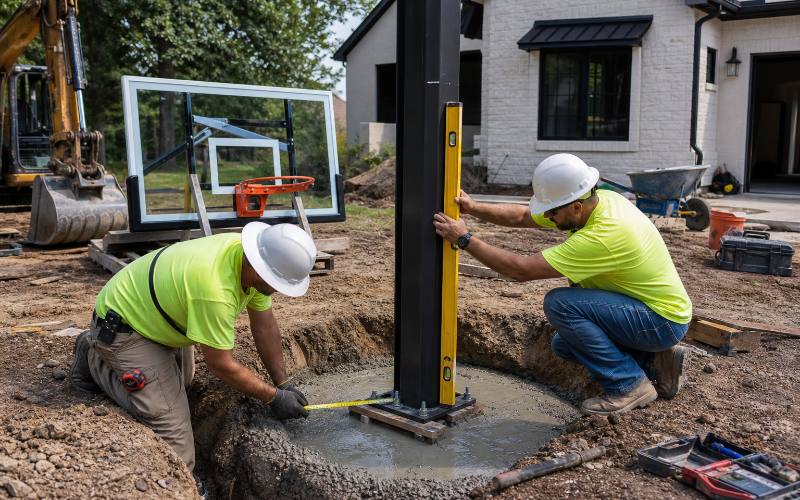
**In-ground systems** demand significant upfront planning and installation. This involves excavating a hole, pouring a concrete footing, and mounting the anchor plate or J-bolt system. Installation can take several days, including concrete curing time, and often requires professional contractors. Once installed, relocation is practically impossible without major construction work, making them a permanent fixture.
Durability & Longevity: Built for High-Volume Use
For commercial and institutional use, durability is paramount. **In-ground hoops** are engineered for maximum resilience. Their heavy-gauge steel poles (often 11-gauge or thicker, typically 4″x4″ to 8″x6″) are typically powder-coated or galvanized for superior weather resistance and prevention of rust. Tempered glass backboards (½” or ⅜” thick) are highly impact-resistant and offer excellent rebound properties, making them suitable for rigorous play over decades. Professional-grade breakaway rims are designed to withstand aggressive dunking.
**Portable hoops** vary widely in quality. Entry-level models may feature lighter steel poles and polycarbonate or acrylic backboards, offering less resistance to long-term outdoor exposure and heavy use. High-end portable units, however, can feature similar robust poles and backboards, but the stress on the base mechanism due to repeated movement and play can still impact overall longevity compared to a fixed in-ground system.
Stability & Safety: Critical for Public and Commercial Settings
**In-ground hoops** provide the highest level of stability. Bolted securely into a concrete foundation, they are virtually tip-proof, making them the safest option for unsupervised public access areas, schools, and community parks where safety standards are stringent. The fixed nature also means less risk of unintended movement during play.
**Portable hoops** rely on their weighted base for stability. Proper ballasting with water or sand (often 30-50 gallons or 300-500 lbs of sand) is crucial. Insufficient weight can lead to tipping, especially during aggressive play or high winds, posing significant safety risks. B2B buyers must prioritize models with large, stable bases and ensure clear guidelines for proper ballast application and regular checks, especially in public-facing environments.
Cost Analysis: Initial Investment vs. Long-Term Value
**Initial Cost:** Portable hoops often appear to have a lower upfront cost, especially considering self-installation. However, high-quality, professional-grade portable systems with larger backboards and robust construction can be quite expensive, sometimes comparable to mid-range in-ground systems.
**Installation Cost:** This is a major differentiator. In-ground systems incur significant costs for excavation, concrete, and potentially professional labor. Portable systems save on these expenses, requiring only assembly.
**Long-Term Value & Maintenance:** In-ground hoops, with their superior durability, typically have lower long-term maintenance and replacement costs. They are built to last for decades with minimal intervention. Portable hoops might require more frequent repairs (e.g., base leaks, wheel damage) or earlier replacement, especially if exposed to harsh elements or heavy use without proper care. When evaluating total cost of ownership (TCO), in-ground systems often present a better long-term investment for permanent facilities.
Performance & Playability: Meeting Athlete Expectations
Serious players, whether in a school gym or a public court, value a consistent and authentic playing experience. **In-ground hoops** with tempered glass backboards (FIBA standard for competitive play) provide true rebound, minimal vibration, and a rigid, professional feel. This translates to better shot accuracy and a more satisfying game. The solid pole structure ensures the rim remains stable even during aggressive dunks. **Portable hoops** often exhibit some degree of backboard vibration and pole sway, especially with polycarbonate or acrylic backboards. The large base can also intrude on court space, limiting baseline play. While sufficient for casual play and training, they may not meet the expectations for high-level competitive environments.
Space Utilization & Site Requirements
**Portable hoops** excel in facilities with limited space or those that need to convert areas for different sports. They can be rolled out for basketball and stored away to free up space for volleyball, events, or other activities. No permanent footprint is required beyond a flat playing surface. **In-ground hoops** demand a dedicated space. Once installed, that area is permanently assigned to basketball. This requires careful planning to ensure proper court dimensions, safety run-off zones, and no interference with underground utilities or future development plans. This commitment of space is a major consideration for facility planners.
Maintenance & Weather Resistance
**In-ground systems** generally require less routine maintenance beyond occasional cleaning of the backboard and checking for any loose bolts. High-quality systems with galvanized or powder-coated steel are highly weather-resistant, with minimal risk of rust or degradation from sun, rain, or snow, making them ideal for year-round outdoor use.
**Portable systems** need more active maintenance. The base’s water/sand ballast needs regular checks to prevent leaks or freezing in cold climates (antifreeze can be added). Wheels and moving parts may need lubrication. While some portable hoops are designed for outdoor use, their exposed bases and typically lighter materials can be more susceptible to weathering, fading, and degradation over time, especially if not stored indoors during off-season.
Customization & Branding Potential
Both types of hoops offer customization options, but with different nuances. **In-ground systems** can be customized with specific backboard padding colors, pole protection, and even custom logos on tempered glass backboards. This is common for school sports teams or sponsored public courts, enhancing brand visibility and team spirit.
**Portable hoops** also allow for backboard graphics and pole padding. However, due to their often temporary nature and varied applications, extensive branding might be less emphasized unless it’s for a specific event or sponsored training facility. EVERGRANDSPORT offers bespoke manufacturing solutions for both types to match specific client branding requirements.
Technical Specifications & Material Considerations
| Feature | Portable Basketball Hoops | In-Ground Basketball Hoops |
|---|---|---|
| Backboard Material Options | Polycarbonate, Acrylic (thickness 3-5mm), occasionally Tempered Glass (entry-level commercial) | Tempered Glass (thickness 8mm-12mm), Acrylic (commercial-grade) |
| Backboard Size Range | 44″ to 60″ (112cm to 152cm) | 54″ to 72″ (137cm to 183cm) |
| Pole Construction | Square or Round Steel (14-12 gauge), multi-piece assembly, powder-coated | Square or Rectangular Steel (11-7 gauge), 1-2 piece assembly, powder-coated or galvanized |
| Pole Dimensions | 3.5″ to 5″ (8.9cm to 12.7cm) square or round | 4″x4″ to 8″x6″ (10x10cm to 20x15cm) |
| Rim Type | Standard static, single spring breakaway | Double spring breakaway (Pro-style, often DIN/FIBA certified) |
| Base System | Large plastic base filled with water/sand (35-55 gal / 300-500 lbs) with wheels | Concrete anchor kit (J-bolts or direct burial sleeve) |
| Height Adjustment | Telescoping, crank, or pneumatic assist (7.5ft to 10ft) | Crank, hydraulic assist (5ft to 10ft, depending on model) |
| Weather Resistance | Good, but base may require freeze protection; exposed components | Excellent (galvanized/powder-coated steel), built for all-weather permanent outdoor installation |
Backboard Materials: Acrylic, Polycarbonate, Tempered Glass
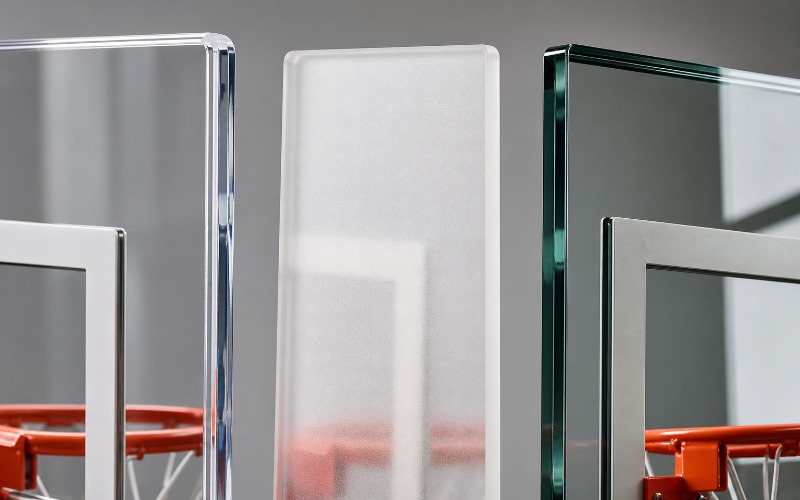
- **Polycarbonate:** Offers good impact resistance, more affordable, but can yellow and scratch over time, affecting clarity and rebound. Common in mid-range portable hoops.
- **Acrylic:** Clearer than polycarbonate, better rebound, but less impact resistant and prone to scratching. Found in higher-end portable and some entry-level in-ground systems.
- **Tempered Glass:** The professional standard. Provides superior clarity, consistent true rebound, and excellent resistance to scratching. Extremely durable against impacts, though it can shatter if hit hard enough in specific weak points. Preferred for in-ground systems in schools, universities, and competitive venues.
Pole Construction: Steel Gauge, Coating, Design
For both types, pole material is typically heavy-gauge steel. The lower the gauge number, the thicker and stronger the steel. Commercial-grade hoops will feature 11-gauge to 7-gauge steel. Powder coating or galvanization is crucial for outdoor hoops to prevent rust and corrosion, ensuring longevity in various climates.
Rim Types: Standard, Breakaway, Double Spring
- **Standard Rim:** Fixed, rigid, and suitable for recreational play where dunking is not expected. Not recommended for B2B or public use due to potential injury and equipment damage.
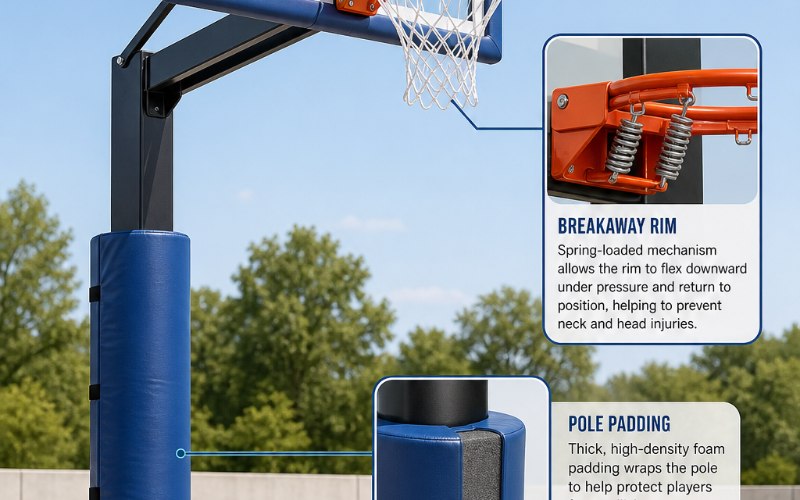
- **Breakaway Rim (Single Spring):** Designed to flex downward upon impact, reducing stress on the backboard and player injury. Good for general recreational and school use.
- **Double Spring Breakaway Rim:** Offers superior performance and durability, with two springs providing increased flex and snap-back action. This is the gold standard for competitive play and high-traffic public courts, meeting FIBA and NCAA specifications.
Base Systems: Water/Sand Fill vs. Concrete Anchoring
- **Portable (Ballast):** Large, heavy-duty molded plastic bases filled with water (more convenient, but susceptible to freezing) or sand (heavier, more stable, but harder to fill/empty). The base capacity directly relates to stability.
- **In-Ground (Anchoring):** Utilizes a steel anchor system set into a deep concrete foundation. This can be a J-bolt system where the pole bolts to a ground plate, or a direct burial system where the pole sleeve is encased in concrete. This creates an unyielding, permanent structure.
Selecting the Right System for Your Project
For Schools and Universities: Balancing Durability and Versatility
**In-ground systems** are typically preferred for main outdoor courts and dedicated gymnasiums due to their superior durability, safety, and professional playability. For secondary courts, practice areas, or multi-purpose halls where courts need to be cleared, **high-quality portable hoops** can be an excellent supplementary choice, offering flexibility without compromising too much on performance and safety (when properly ballasted).
For Community Centers and Parks: Public Safety and Vandalism Resistance
Here, **in-ground hoops** are almost always the superior choice. Their permanent, robust installation minimizes vandalism risk and ensures maximum safety for unsupervised public use. Look for systems with hot-dip galvanized poles and tamper-proof hardware. Portable hoops are generally not recommended for unsupervised public park settings due to stability concerns and potential for theft or vandalism.
For Sports Equipment Distributors: Inventory and Market Demand
Distributors should maintain a diverse inventory. **High-quality in-ground systems** appeal to institutions, contractors, and higher-end residential clients seeking permanent solutions. **Robust portable systems** cater to schools needing flexible setups, smaller community groups, and the mid-to-high end residential market. Understanding regional demand, climate conditions (e.g., preference for more weather-resistant in-ground in harsh climates), and common project types will guide inventory decisions.
Ensuring Compliance and Safety Standards
Regardless of the type, ensure that all basketball hoop systems procured comply with relevant safety and performance standards. Key standards include:
- **FIBA (International Basketball Federation) Standards:** Essential for competitive and professional-grade equipment, particularly for backboard dimensions, rim specifications, and overall stability.
- **ASTM (American Society for Testing and Materials) F2549:** Standard Consumer Safety Performance Specification for Home and Commercial Play Equipment.
- **EN 1270:2006 (European Standard):** Specifies functional and safety requirements, and test methods for basketball equipment.
- **Local Building Codes & Safety Regulations:** Always verify compliance with local codes for public installations.
EVERGRANDSPORT: Your Partner in Superior Sports Equipment
At EVERGRANDSPORT, we specialize in manufacturing both cutting-edge portable and robust in-ground basketball systems designed to meet the rigorous demands of B2B applications worldwide. From schools and community centers to sports clubs and municipal projects, our extensive range of products adheres to international quality and safety standards. We offer customizable options, competitive wholesale pricing, and expert guidance to help you select the ideal basketball solution for your specific project needs. Partner with us for reliable, durable, and high-performance sports equipment. **Contact EVERGRANDSPORT today for a detailed quote or to discuss your project requirements.**
Frequently Asked Questions (FAQ)
In-ground units offer significantly superior stability as they are permanently anchored in concrete, making them virtually tip-proof. Portable hoops rely on their weighted base (filled with water or sand) for stability; while high-quality portable units are stable when properly ballasted, they will never match the inherent rigidity of a fixed in-ground system, especially under aggressive play or high winds.
For public use, safety is paramount. In-ground hoops are generally safer due to their fixed stability and robust construction, minimizing tipping hazards. For portable hoops, ensuring the base is always fully ballasted, regular checks for leaks or damage, and proper positioning away from hazards are crucial. Both types should have backboard padding and clear instructions for safe use, complying with standards like ASTM F2549 or EN 1270.
No, in-ground basketball hoops are designed for permanent installation. Once the anchor system is set in concrete, relocating the hoop would require extensive excavation and concrete work, effectively reinstalling a new system. This permanence is a key factor in their stability and durability but removes any flexibility for movement.
High-quality in-ground systems, especially those with galvanized steel and tempered glass, can last 20-30 years or more with minimal maintenance, even in outdoor conditions. Portable hoops generally have a shorter lifespan, often 5-15 years, depending on material quality, frequency of use, and exposure to elements. Their bases and moving parts are more susceptible to wear and tear.
Yes, both portable and in-ground hoops can be customized. Common customizations include backboard graphics (e.g., school logos, team branding), backboard padding colors, and pole padding. EVERGRANDSPORT offers bespoke manufacturing to meet specific aesthetic and functional requirements for B2B clients.
In-ground hoops require minimal maintenance: occasional cleaning of the backboard and pole, and checking bolts for tightness. Portable hoops require more active maintenance: regularly checking and refilling the base ballast (especially for water-filled bases), ensuring no leaks, adding antifreeze in freezing climates, lubricating wheels, and inspecting the adjustment mechanism for proper function. Both should have their rims and nets checked for wear.