The standard basketball hoop height of 10 feet (3.05 meters) is universal across amateur and professional play. This measurement originated from the physical constraints of a gymnasium railing and has endured for over 130 years. Understanding why 10 feet became the benchmark reveals a blend of historical accident, human anatomy, and competitive balance.
If you are looking for more about basketball hoop, you can visit our Basketball Hoop Guide.
Key Takeaways
- The 10-foot height was set by Dr. James Naismith in 1891 based on the available balcony railing in the Springfield gymnasium.
- This height creates an optimal challenge for shooting accuracy and requires players to develop arc and precision.
- Standardization by major leagues (NBA, NCAA, FIBA) reinforces the 10-foot height globally.
- Adjustable basketball hoops allow younger players and recreational users to train at appropriate heights.
- Technical specifications such as rim diameter (18 inches) and backboard size also contribute to fair play.
The Origin: Why Did Naismith Choose 10 Feet?
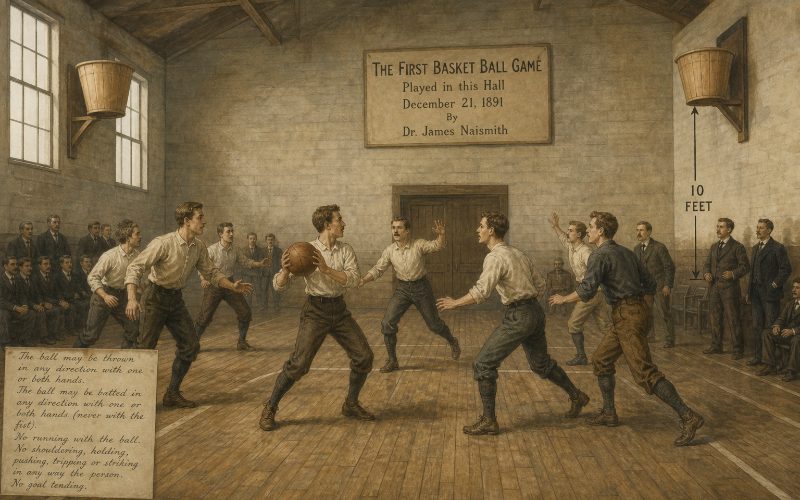
In December 1891, Dr. James Naismith nailed a peach basket to the balcony railing of the Springfield YMCA gymnasium. That railing happened to be 10 feet above the floor. Naismith did not deliberately calculate an ideal height; he used what was available. The game’s first 13 rules did not specify a basket height, but the 10-foot standard took hold because no one could find a compelling reason to change it.
As basketball spread, gymnasiums were built with 10-foot ceilings or balconies at that height. Early adopters replicated the YMCA setup. By 1900, the 10-foot hoop became the de facto norm. The rule was formalized in 1906 when the basket backboard was introduced, securing the height as a permanent fixture.
Physics of Shooting: Why 10 Feet Creates the Perfect Arc
A 10-foot hoop demands a specific launch angle and velocity for a successful shot. For an average player standing 6 feet tall, the rim is roughly 4 feet above their head. This vertical gap forces players to shoot with a high arc, typically between 45 and 55 degrees, to maximize the chance of swishing through the net.
The geometry of a 10-foot goal also influences rebounding and defense. A lower rim would make layups and dunks trivial, while a higher rim would eliminate the jump shot and reduce scoring. The 10-foot height strikes a balance that rewards both accuracy and athleticism. Studies in sport biomechanics confirm that this height optimizes the trade‑off between difficulty and repeatability.
International Standards: How the 10-Foot Height Became Universal
The International Basketball Federation (FIBA) and the National Basketball Association (NBA) both mandate a rim height of exactly 10 feet (3.05 meters). The NCAA and high school associations follow the same rule. This uniformity ensures that players can transition seamlessly between different leagues and continents.
Even the Women’s National Basketball Association (WNBA) and most women’s college leagues use the 10-foot rim. Despite physiological differences, the height remains the same to preserve the integrity of the game and allow co‑ed training. Only youth leagues and adaptive sports intentionally lower the rim.
Adjustable Basketball Hoops: Flexibility Within the Standard
For training and youth development, adjustable basketball hoops allow height changes from 7.5 feet to 10 feet. These systems use telescoping poles or pneumatic lifts. They help young players develop proper shooting form without developing bad habits caused by an excessively heavy ball or oversized goal.EVERGRAND Sport offers a range of adjustable in‑ground and portable hoops that meet ASTM safety standards. When the adjustment mechanism is locked, the rim holds rigid at any setting. This versatility makes adjustable hoops ideal for schools, community centers, and home driveways.
Technical Specifications of a Standard Basketball Hoop
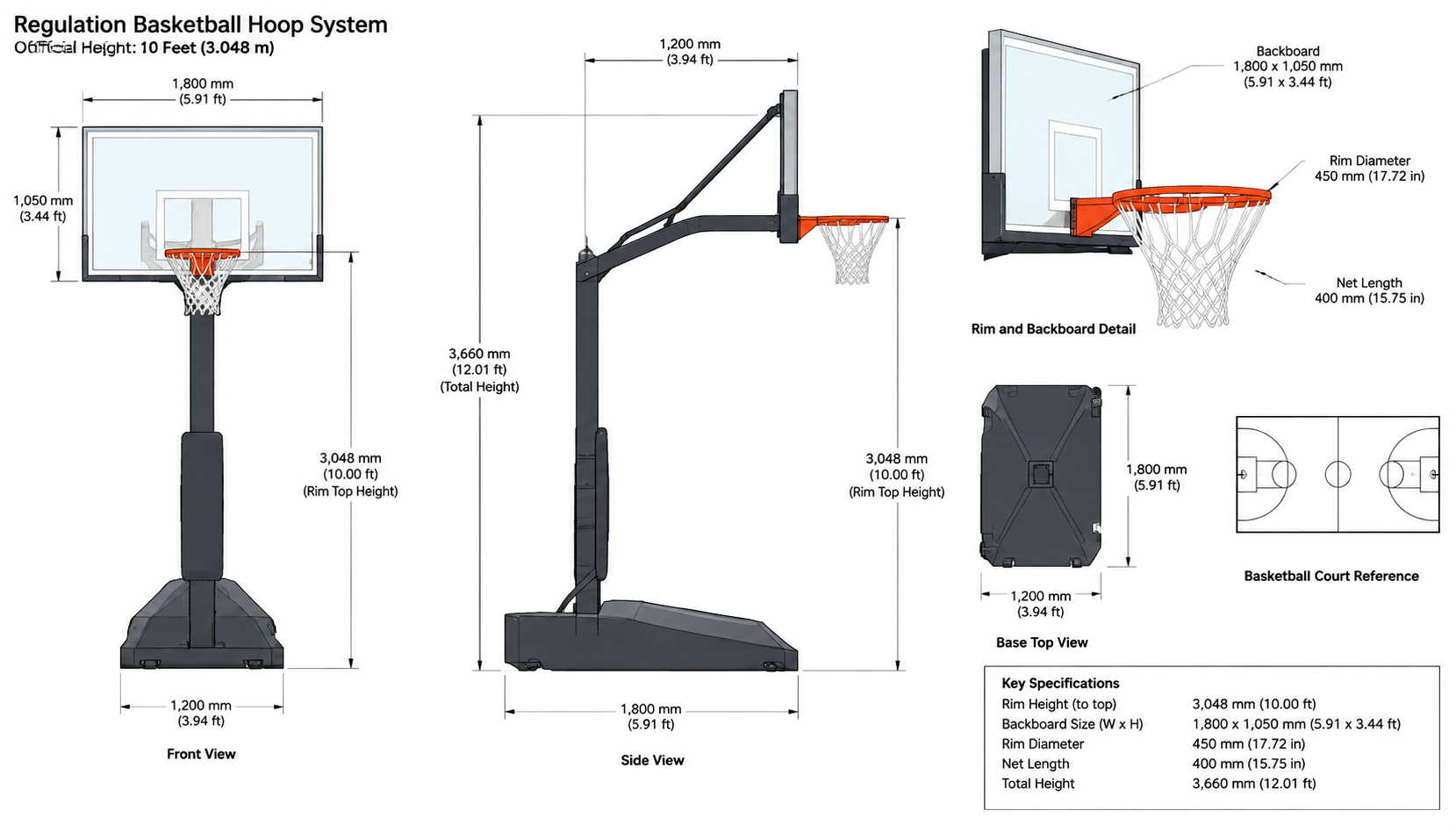
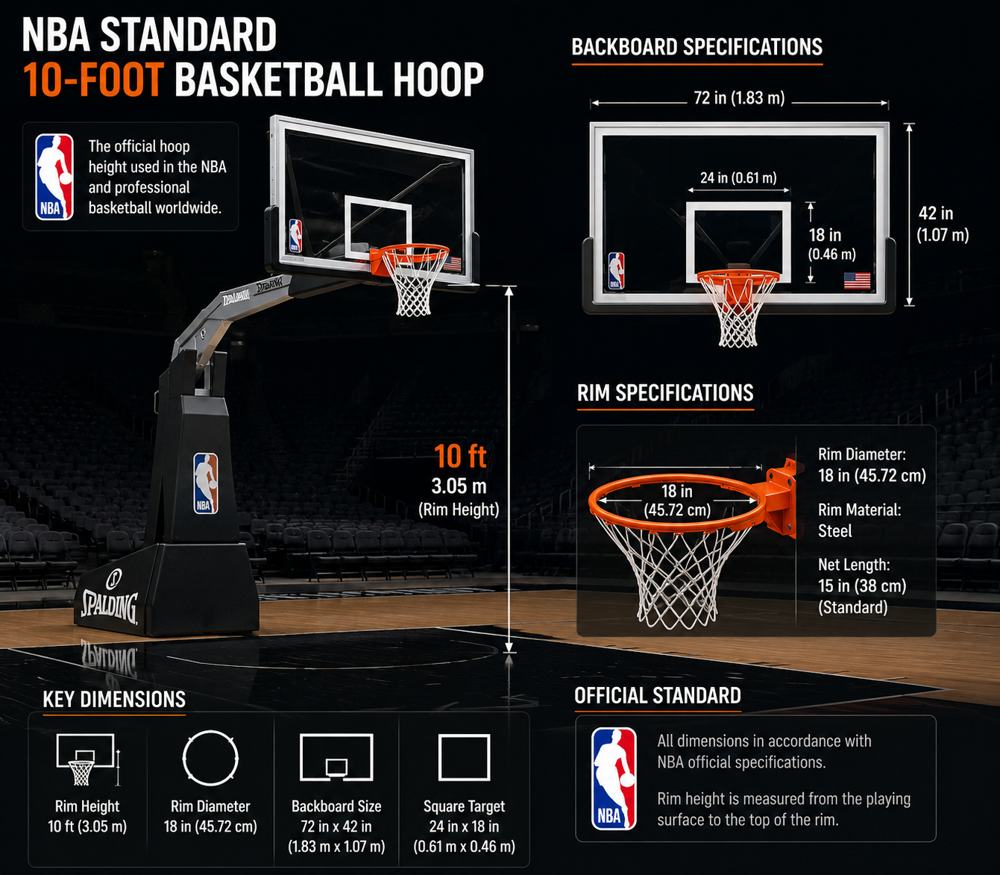
Beyond the 10‑foot height, several other dimensions are standardized to ensure fair play. The table below summarizes the key requirements from major organizations.
| Parameter | NBA | FIBA | NCAA | High School |
|---|---|---|---|---|
| Rim height | 10 ft (3.05 m) | 10 ft (3.05 m) | 10 ft (3.05 m) | 10 ft (3.05 m) |
| Rim diameter | 18 in (45.72 cm) | 18 in (45.72 cm) | 18 in (45.72 cm) | 18 in (45.72 cm) |
| Backboard width | 6 ft (1.83 m) | 1.8 m | 6 ft (1.83 m) | 6 ft (1.83 m) |
| Backboard height | 3.5 ft (1.07 m) | 1.05 m | 3.5 ft (1.07 m) | 3.5 ft (1.07 m) |
| Backboard thickness | 5/8 in (16 mm) | ≥ 10 mm | 5/8 in (16 mm) | 5/8 in (16 mm) |
| Breakaway rim offset | 0.25 in (6.35 mm) | ≤ 10 mm | 0.25 in (6.35 mm) | N/A |
These specifications ensure consistency from the driveway to the professional arena. The 18‑inch rim diameter, for example, is exactly twice the diameter of a standard basketball (9.55 inches), providing enough margin for swishes while still challenging the shooter.
Frequently Asked Questions
The height was set by Dr. James Naismith when he hung a peach basket on a balcony railing exactly 10 feet above the floor. It has remained the standard ever since because it provides an optimal challenge for shooting and scoring.
Yes, the WNBA and most women’s collegiate leagues use a 10-foot rim. Although female players tend to have lower average vertical leaps, the height is consistent to maintain the same game structure and allow transferable skills.
Absolutely. Adjustable hoops allow heights from 7.5 to 10 feet. Youth organizations often lower the rim to 8 or 9 feet so children can learn proper shooting mechanics and build confidence.
The rim must be 18 inches in diameter and the backboard typically 6 feet wide by 3.5 feet tall for professional play. The rim height is always 10 feet.
No significant governing body has altered the rim height. Some have proposed raising it for taller players, but tradition and the difficulty of retrofitting all courts have kept it at 10 feet.
Most players train on a 10-foot rim to ingrain the correct arc and release point. Lowering the rim for training can develop poor habits. Adjustable systems are best used for progressive skill development, not permanent changes.
Conclusion: The 10-Foot Standard Continues to Define Basketball
The 10-foot basketball hoop is a product of happenstance refined by practicality. It has become the bedrock of the sport’s identity, influencing shooting technique, defensive strategies, and the very physics of the game. Whether you are a school district outfitting a new gym or a coach designing a training plan, understanding the rationale behind this height helps you make informed decisions.EVERGRAND Sport manufactures high‑quality basketball hoop system that comply with international standards. Our adjustable systems allow safe progression without sacrificing durability. Contact our team for wholesale pricing and custom specifications.
Request a quote today to bring professional‑grade hoops to your facility.